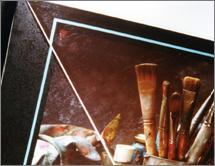
 Photo 1
What is the conservation approach to handling a Cibachrome, is only half the question. How is a cibachrome best presented, might be the rest of the question. I realize far too many people think of them just as fancy high gloss photographs which are a pain to handle and can be mounted as any other photograph. In actuality, cibachromes are no more like any standard RC (resin coated) photo than a Polaroid is.
Polyester Based Cibachromes
Ilford Color Products set the standards for production of color prints and transparencies through the development of it's Cibachrome process. In 1991, ILFORD changed the name of it's patented "Cibachrome" to "Ilfochrome Classic".
Glossy Ilfochrome Classics are based on a unique silver dye bleach system using azo dyes which are incorporated during manufacturing, different from RC images which form dyes from color couplers during developing. Cibachromes therefore offer excellent image stability, crispness and the most lightfast color photo process currently available. In fact, under specified conditions and with proper developing and materials, the process is guaranteed against color shift by Ilford for 200 years.
The "Deluxe Glossy" surface materials have an opaque white polyester base 7 mils thick coated on the back with a matte gelatin layer. The 100% polyester base makes the photo print more dimensionally stable while the gelatin backing equalizes the surface tensions making them lie flat.
Other Cibachrome Materials
Besides the Ilfochrome Classics, Ilford makes an extensive line of additional Cibachrome print materials from transparency display films to RC emulsions. The same cibachrome emulsion as above is available as a semimatte finish or "Pearl Surface" on a resin-coated paper core base, making it an RC photograph. Though a beautiful image, it does not showcase the same high gloss, long term color permanence as the polyester based materials described above.
Substrate Selection
The key challenge is to maintain the smooth gloss surface of a cibachrome, without creating "orange peel". This is when the glossy photo surface exaggerates the visual texture of the underlying substrate material appearing pebbly or lumpy. Substrates, therefore, play an important part in this equation. Aluminum and plastics such as Lexan make excellent substrates because of their dimensional stability (won't expand/contract with humidity) and generally smooth surfaces.
Most other possible mounting materials have their own individual problems. Mat boards, paper based mounting boards, and most foam center boards create orange peel. Rigid surfaced boards (Gatorboard, Ryno-board, Masonite) may be smooth but outgas formaldehydes unsuitable for archival storage. Regardless of the selected substrate, one needs to remember that the total amount of overall pressure applied during mounting will also impact the overall detectable visual orange peel.
Handling and Mounting Suggestions
In general, special handling procedures should always be initiated when dealing with photographs, but cibachromes are much more sensitive than RC. Pearl surface RC cibachromes are no more sensitive than a normal RC and routine photo handling procedures apply to them. In fact, they are often almost indistinguishable from any other RC aside from the developing paper stating "Cibachrome" or "Ilfochrome Classic" on the back. They may be mounted, laminated and canvas transferred as any RC photo.
White cotton photo gloves should always be worn during examination at the design table and while framing to prevent finger oils and fingerprints. Moisture from one's own breath when blowing dust from the surface can produce permanent water spots, while wiping the surface with a clean rag can develop severe scratches in the sensitive emulsion (photo 1/top right).
Photo 1
Being much more sensitive in nature, polyester Ilfochrome Classics require alternative methods for mounting. The question is never "can it be mounted", as in whether the polyester will tolerate the heat of dry mounting, but rather "should it be mounted", in that the heat may effect the visual deluxe gloss surface of the image.
Cibachromes will not physically melt until reaching the 300ºF range, but will begin to reflect the substrate texture—orange peel—at low end 170ºF heat settings. Normal mounting temperature ranges of 180-200ºF will increase the visual texture (orange peel) and excess temperatures of 210ºF will also damage the gloss emulsion by mottling or blotching it significantly (photo 1/left side).
Ilford recommends cold mounting or low temperature heat applications for cibachromes. In the photo industry, cold mounting sometimes defines as "dry mounting without heat" as when pressure-sensitives are the adhesive of choice (3M PMA, Crescent Perfect Mount).
In the framing industry, any form of mounting without heat is cold mounting (wet, spray or P-S) but they aren't always dry applications (wet, spray). Confused? Just remember if you are dealing with a photographer, dry mounting does not always mean "heat" applications with a press, it can mean pressure-sensitive too.
Alternative to Mounting
There are perhaps better solutions or alternatives to physically mounting a cibachrome which maintains the initial dignity of the pure Ilfochrome Classic high gloss appearance. Though the manufacturer may lean toward affixing the photo to a backing, the more acceptability archival version would be to use corner pockets; edge strips; T-, pendant, or flange hinges. Hinging remains the most reversible and non-invasive method for mounting, and hinging in connection with use of static electricity can maintain the image dignity while effectively holding the photo in place (photo 2).
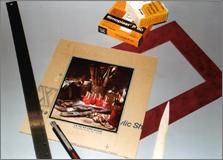 Photo 2
Buckling and Warping
Cibachromes are flat but floppy. The larger the print (bigger than 11x14") the more they have a tendency to buckle from their own weight, potentially slipping out of upper corner pockets and slouching in the center of the mat window. So edge strips which support around the photo or hinges might sound preferable.
There is also a tendency, however, with larger images (16x20" and up) for the center of the polyester print to be sucked to the surface glazing due to static electricity. Even when hinging preserves the dignity of the smooth surface and there appears no orange peel, there can be a warping toward the glass.
The Static Process
The idea is to create a mini "sink mat" out of the protective plexi surface paper. The plexi is cut to desired mat board size along with the selected mat(s). Cut mat opening, with gloved hand align photo into centered position onto paper covered plexi and draw pencil line around actual exact borders of Cibachrome print (photo 3).
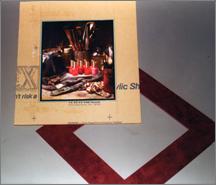 Photo 3
Set print aside, score protective paper about ¹⁄₆₄" larger around exact pencil lines and peel center protective paper away from plexi. The remaining surface paper will act as a thin mini sink mat to hold small cibachromes into position through the static and window mat alone.
If photo is to be shipped or aggressively handled as in hung in numerous locations during exhibition. Try a combination of flange hinging and the natural creation of static electricity from a peeled piece of Plexiglas acrylic sheeting, paired for a smoothly dignified mounting presentation. The hinge will flatly support large heavier cibachromes preventing them from buckling while the static maintains the center contacted to the backing, thus preventing warping towards the glazing.
It is recommended to apply the acid-free pressure sensitive flange hinge across the entire top of the photo, not just in typical pendant hinge locations. Flange hinging is applying a folded V-hinge across the entire top of a hinged item (photo 4).
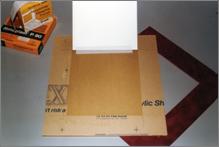 Photo 4
In this case archival Japanese hinging techniques are not required for hinging since the 100% polyester print can not actively absorb adhesives from any pressure-sensitive tape. Also remember, too much moisture when applying starch hinges can create permanent cockling damage at the hinge points with a photo just as with paper.
Final Assembly
Cut the mat window allowing a ¼" overlap onto the cibachrome for additional edge support. It is the lifting of the photo edges that will break the static contact to the backing which holds the photo in place. The mat will ensure the static bond is not broken whether hinged or just static sink mat mounted (photo 5).
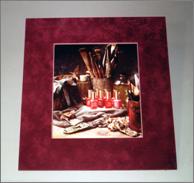 Photo 5
Pricing
Yes, this is a pricier solution to mounting a cibachrome than pressure-sensitive sheet adhesives or Mylar corners, but this is not an everyday photograph either. In order to present the client with the best solution to their framing request, also present the best materials, process and design.
You will need to charge additionally for the extra acrylic sheeting as a mount board, but more effective than aluminum. The best solution to an Ilfochrome Classic challenge is no different than any other as a frame designer, to enhance and protect the art. The Ilfochrome is best enhanced by not destroying it's smooth high gloss surface and protected by not altering or invading it's longevity.
Special thanks to Paul McFarland for giving me this tip years ago on static mounting of cibachrome images. Having played with it extensively and discussed it's pros and cons with numerous photo conservators and fine art photographers, the concept has been a huge success.
END
Copyright © 1997 Chris A Paschke
For more articles on mounting basics look under the mounting section in Articles by Subject.
Additional information on all types of mounting is found in:
The Mounting and Laminating Handbook, Second Edition, 2002,
The Mounting And Laminating Handbook, Third Edition, 2008 and
Creative Mounting, Wrapping, And Laminating, 2000 will teach you everything you need to know about getting the most from your dry mount equipment and materials as an innovative frame designer.
All books are available from Designs Ink Publishing through this website.
Chris A Paschke, CPF GCF
Designs Ink
Designs Ink Publishing
785 Tucker Road, Suite G-183
Tehachapi, CA 93561
P 661-821-2188
chris@designsinkart.com