 Photo Intro
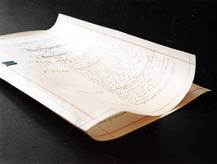
A 1852 ledger page of sheepskin parchment.
Parchment is more sensitive to moisture, heat and pressure than vellum.
This page curled after exposure to 180ºF and too much pressure.
The use of animal skins or "vellum" as a writing surface for the recording of history and acknowledging accomplishments has long been an accepted practice, and skins have survived from as early as Egypt 2500BC. Calf, goat and sheep were normally used, but skins of gazelle, antelope, stag and even ostriches have also been located and preserved. Vellum is the proper name given to any high quality animal skin—excluding sheep or lamb—prepared specifically for the arts of writing, bookbinding and printing (photo-intro).
Photo Intro
A 1852 ledger page of sheepskin parchment.
Parchment is more sensitive to moisture, heat and pressure than vellum.
This page curled after exposure to 180ºF and too much pressure.
Vellums are available in a range of sizes and qualities (photo 1) including "Grained" premium quality, "Classic" used mostly for historically framed declarations and heraldry and "Manuscript" thinner version of Classic, all developed from calfskins. Goatskins such as "grained goat" and "yellow or white goat" have much more open grain textures than calf, are rougher, less expensive and often used in bookbinding. Uterine vellum—from an unborn calf—is the thinnest and highest quality vellum available. It is extremely smooth, comes from the belly of still-born calves and although rarely made and quite expensive, may be special ordered.
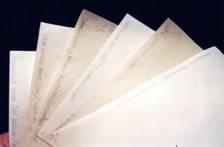 Photo 1
From L to R: Manuscript calf (medium weight); Manuscript slunk calf (book weight);
Classic writing calf; Manuscript calf (#3 medium weight); White goat; and Parchment (sheepskin).
Note the variation in texture, grain, color, veining and shading.
In layman's terminology, all writing skins are generally referred to as "parchment" though the only true parchment comes from sheep. There are also degrees of quality available when it comes to sheep or lambskins, including "Roman vellum" (a shinier, absorbent version made as an imitation of vellum, named for its use in the Vatican); parchment (hard, smooth surfaced, white and oily, the finish resembles that of an eggshell) and Forel (inferior quality skin produced in white and tints). The quality of Forel compares to parchment as goat vellum compares to calf vellum.
Preparation
The distinct difference between "vellum" and "parchment" preparation directly effects the basic characteristics and reactions of each type of skin. In order for today's framer to be able to deal with the assorted documents, maps, certificates and ledger sheets that may cross his framing table, a basic understanding of skins really helps. It is important to note that most often you will be dealing with sheepskin parchment, for vellum is most dominantly used in book leaves and royal declarations.
Vellum skins are soaked in lime to remove the hair, scraped, washed, stretched and room dried. Parchment—sheepskins only—must be split, limed and scraped 2-3 times to remove the additional fat from the skins prior to degreasing. Then they are shaved, whitened and dried unstretched in a hot drying room to remove further fat, then washed and cleaned for final use. Visually, vellums are often naturally creamy in color and often illustrate the veining of the animal, while parchment is much whiter and has a smoother surface texture.
Reflattening With Water and Pressure
Skins may be redampened to relax them in an attempt to reflatten prior to framing. Tests must be done on the document prior to dampening to determine the permanence of the inks and pigments used. With a dampened Q-tip, touch each individual color lightly to check for bleeding or lifting of color. A 50/50 solution of alcohol and distilled water should be used during this process, and dampening is generally done from the back of the document with a cotton ball or squeezed sponge. Another version is transferring moisture into the skin by moistening a blotter and then placing it in contact with the back of the skin.
Since vellums are originally dried on frames much like stretcher bars, when dampened they will cockle and warp, and attempt to revert to the original shape of the animal as they dry (if left to dry under no restraints). So to reflatten vellum, it must be dampened and dried under tension or pressure (photo 2). If the skin is to be matted, 2" felt lined Bulldog clips may be positioned around the edges of the dampened vellum while pinning it with stainless steel pins to a stretching board (as is used with needlework). Vellum is really quite forgiving in it's tolerance for water. If any of the originally painted pigments have turned powdery or loose, they may be painted over with a thin solution of soluble nylon in I.M.S. (industrial methylated spirit)...and never dampen gold.
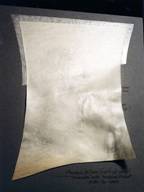 Photo 2
This classic sample was soaked in water and allowed to air dry, causing the lower right corner to cockle.
The left corner was pressed flat at 160ºF in a mechanical press for 5 minutes.
The top was mounted to a 4-ply board with ArchivalMount tissue at 180ºF for 2 minutes.
Heavily dampening parchment will both effect the surface finish and shrink the skin, about 5% overall (photo 3). To lessen these dramatic effects, use the lightly dampened blotter method by pressing it to the skin for just a few seconds. Then press the parchment between clean, dry blotters under even weight like that of a closed (not locked) cold mechanical press. Too much pressure may also cause later curling when dry. Change the blotters every ½ hour until completely dry. Do not leave damp blotters in contact for extended periods to the skin as it promotes mold growth. Most skins will water stain (some worse than others) so spot dampening should always be avoided and parchment will definitely want to curl (photo 4). Remember, parchment is much more delicate and reacts much more violently when mishandled. Predictability is the key, always know what will happen prior to doing anything. Many applications (moisture and heat) individually are quite safe, but when applied in collaboration can be deadly to that "one-of-a-kind" sheepskin ledger page from 1852 (photo 5).
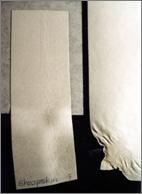 Photo 3
Left sample has been dampened and air dried causing shrinkage.
Right sample illustrates the unfortunate combination of moisture AND heat application.
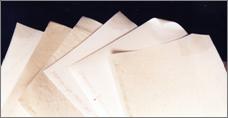 Photo 4
First four (L to R) are calf vellum, with a little cockling and water staining.
The fifth is sheepskin parchment (curled).
Unlike parchment, vellum will often flatten under heat.
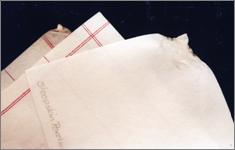 Photo 5
Tested samples reacted when heat and moisture were applied.
Left was heat and pressure; center was dampened and air dried prior to heat.
Right is a more drastic version of heat, moisture and pressure.
Mounting
Since vellum and parchment are naturally prone to buckling, often clients prefer to have them mounted permanently flat! In actuality, documents, certificates and diplomas should be treated in the same manner as a fine art original. Museum mounting using all the standard conservation methods of hinging with wheat starch and Japanese hinges on only acid-free 4-ply boards should always be stressed. Slight buckling of a skin with natural temperature and humidity changes truly is the nature of the beast. It is the one element exclusive to this fine art original and I personally am an advocate of maintaining that natural beauty. Other options for mounting skins include: stretching over coated bars or acid-free museum board and affixing to the back; wet mounting with adhesives specified for skins; and dry mounting. Additional heat applications involve Lamin-all (a heat setting wet glue) and Parchweld. Both of these last two methods involves a combination of taping, heat and pressure. Even when vellum is stretched like canvas it will cockle as time passes and the natural effects of the above mentioned temperature and humidity tightens and relaxes it. Of course the ideal environment is 60-70F with 50% relative humidity, a basic thermostatically controlled museum environment.
When a dogmatic client pursues the more static and flat look, dry mounting fully dried skins with low temperature, removable, acid-free tissues is quite simple and effectively successful. Acceptable dry mount tissues include ArchivalMount, TM-4 and Drychival.
Heat Applications
Vellum will notoriously tolerate much greater temperature and moisture abuse than parchment. Applying heat alone to skins will not radically effect them as long as it is not too hot. Tests show that temperatures of 180ºF for up to 5 minutes will not do damage to either vellum or parchment samples, although a tendency toward brittleness does begin to occur.
High temperatures of over 200ºF will be asking for trouble, for parchment could easily be fried. Care should always be taken when applying heat of any kind, though 160ºF for 3 minutes to set any low temperature tissue is very safe (photo 3, sheepskin onto ArchivalMount).
A combination of heat and pressure while damp will slightly shrink vellum (almost undetectably), while it will do major damage to parchment (photo 6). Make certain any skin having been dampened to flatten is totally dry prior to mounting to avoid any irreversible damage. Use your common sense, vellum and parchment are both natural animal skins and will readily react to other natural elements safely, when adding extremes of heat (an unnatural element) the other elements need to be totally under control.
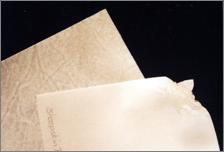 Photo 6
Classic calf (L) and tortured sheepskin (R) after water, heat, and pressure.
Both stretched and mounted versions of presentation are unnatural to vellum and parchment, for once again it assumes an inconsistent character from the true natural look. If archivally hinged, skins should be placed ⅛" from the glazing for room to breathe, which can easily be achieved by using multiple acid-free window mats (this pressure against the edges of the vellum will also minimize overall buckling. Once framed these pieces of fine art must be hung in a dry (but not too hot) location, preferably out of direct sunlight. Taken well care of, these archivally preserved masterpieces will last many future generations.
If dealing with a seriously curled document feels beyond your scope of confidence, contacting a qualified conservator for assistance or as a subcontract for this project is always a very viable option. Other than that, hinging the (original once safely reflattened) and allowing it to move freely is truly after all…the nature of the beast.
END
Copyright © 1992 Chris A Paschke
For more articles on mounting basics look under the mounting section in Articles by Subject.
Additional information on all types of mounting is found in:
The Mounting and Laminating Handbook, Second Edition, 2002,
The Mounting And Laminating Handbook, Third Edition, 2008 and
Creative Mounting, Wrapping, And Laminating, 2000 will teach you everything you need to know about getting the most from your dry mount equipment and materials as an innovative frame designer.
All books are available from Designs Ink Publishing through this website.
Chris A Paschke, CPF GCF
Designs Ink
Designs Ink Publishing
785 Tucker Road, Suite G-183
Tehachapi, CA 93561
P 661-821-2188
chris@designsinkart.com