Paschke Online
Designs Ink Publishing Article Archive and Reference Library
Articles by Chris A. Paschke, CPF GCF
"Polyester + Resin-Coated Photograph = Ilfochrome RC"
February 1994
With "conservation" being one of our greatest concerns for the 90's it sometimes feels a bit odd to be writing a monthly column on wet, spray and dry mounting. Even more so after just completing my January column reinforcing conservation as a "trend" for the new year. There are very specific conservation mounting procedures and we are lucky enough to be updated on a regular basis through quality articles in PFM by such credible authors as Hugh Phibbs and Jeff Tichenor on these very issues. But, it appears to be my job to get down to the nitty-gritty on a lot of the more mundane daily mounting problems, questions and concerns.
During workshops and lectures I am often reminded that using the word "photograph" anywhere in a sentence concerning mounting generally raises the red caution flag. Framers often fear items they don't routinely handle and that is often the most healthy approach. You shouldn't really be frightened of the unknown, moreover respect that which you are not comfortably familiar.
Know the Difference
Though as framers you don't often need to know the intricacies of photo developing, it is at least strongly recommended you understand the structural differences between the types of modern day photographs that may cross your threshold, (photo 1) and know how to best handle them.
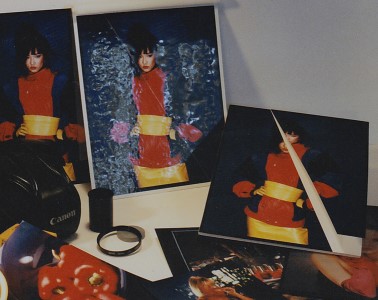 Photo 1
Cibachromes are extremely high gloss polyester based photographs which are very susceptible to damage. Note that the horizontal glare reflection on the left (unmounted) image is smooth and sleek. The mounted sample in the center illustrates the varying degree of the orange peel effect which occurs during mounting. Sales aids such as these are a necessity.
I specifically wish to address a photo process or type we've come to know as a Cibachrome. While attending a recent photographic show it was quite evident that the photographic industry is progressing at an almost alarming rate. As expected, new equipment, processes in developing and advances in types of film continue to flourish. As framers we need to be aware of a variety of types of items we might be asked to mount, and know not only when to mount but how it may react to the mounting process selected.
Polyester Based Prints
Ilford Color Products set the standards for the production of color prints and transparencies through the development of its Cibachrome process a great many years ago. In 1991, ILFORD changed the name of it's patented "Cibachrome" to "Ilfochrome Classic".
Ilfochrome Classics are developing materials based on a unique silver dye bleach system using azo dyes which are incorporated during manufacturing. They are the most colorfast dyes offering excellent image stability, crispness and the most lightfast color photo process currently available.
For that reason many professional and fine art photographers use the Cibachrome process and materials for developing their images...both as traditional Cibachromes and/or RC Cibachromes. Yes Virginia, there is such a thing!
The ending term "chrome" is used descriptively in conjunction with a particular type of film (Kodachrome, Agfachrome, Fujichrome, Ilfochrome), and it designates a positive slide or transparency being produced from the film rather than a negative. Extreme crispness and clarity in a printed image is the result of prints produced from a "positive to positive" rather than a "negative to positive" as with regular RC prints.
Depending upon the chemicals and papers used in the printing of a photograph, the end print may vary greatly. Since a slide is considered a positive image, any print resulting from a slide is considered a positive/positive print, one where the colors are very crisp, bright and clear; the image remains truest with least distortion; it is most lightfast; and it gives the greatest illusion of depth. With any pos/pos print, color, detail and clarity are never sacrificed by the conversion of a negative to positive when printing. Conversely, a neg/pos is almost like removing the image to a second generation as in photocopying a photocopy.
Resin-Coated Prints
Most of us are familiar with snapshots and photos developed with either satin or high-gloss finish known as RC or resin-coated photographs. RC photographs are made up of a paper core coated two sides with a polyethylene coating topped with a surface emulsion. The polyethylene has been designed to protect the paper core from absorbing water during the actual printing process of photo developing. These photos are most easily identified by the name of the manufacturer generally printed on the back of the photo PAPER BY.
A negative/positive print such as a traditional RC photograph, though still very good, may lack the overall dynamics and vibrancy of a pos/pos RC print using Cibachrome developing materials.
Complicating the Issue
There are numerous companies with assorted photo developing papers helping make photographs quite a mystery to many of us. The two basic modern day types of photos framers need to be familiar with them are Polyester Based or Cibachrome Prints and Polyethylene or Resin Coated Prints. The papers used to print the photo image will determine the type of photo produced. A single roll of slide film once exposed and developed onto a positive slide may then produce a pos/pos polyester based Cibachrome; a pos/pos RC Cibachrome print; or pos/pos Cibachrome transparency for a light box as used in advertising. Regular print negatives do not have the option of becoming RC Cibachrome prints because of the neg/pos printing and must remain regular RC photos. So what does all this mean?
Suggested mounting and handling procedures for a true Cibachrome were discussed at length in "What To Do With Ilfochromes" (PFM October 1992) where I stated the best solution in handling a 100% polyester photo was to hinge or use corners integrating proper conservation methods, and this remains true. But framer beware for some RC photos may also be called RC Cibachromes and confusion is just around the corner.
A Hypothetical Situation
A client has just walked into your store with an 11x14" photograph having been told by her photographer the print is a Cibachrome and should be framed accordingly. As the professional you are, upon examination of the photo you note it appears to be an regular RC photo complete with paper core and lettering PAPER BY... on the back. The surface of the photo is bright, clear and has outstanding color. The finish is not the high gloss familiar to a Cibachrome but rather a non-gloss luster or matte finish. First, is this a Cibachrome? second, how do you mount it? And third, what do you tell your client?
RC Cibachromes
As discussed above an RC Cibachrome is one producing direct positive prints from slides which come in various finishes just as regular RC film prints do. An RC Cibachrome print may be handled in exactly the same manner as a regular RC photo when mounting and framing. All the same rules and problems apply including orange peel, scuffing and the suggested use of non-buffered boards for framing.
 Photo 2
A detail of a split sampler used in selling the proper mounting procedures for a polyester based Cibachrome. Dry mounting reveals orange peel on the left half of the photo, shile the hinged right half remains nicely high gloss.
A polyester Cibachrome image will readily conform to any surface it's mounted to especially if it is heated, for the plastic will soften and remold itself creating extreme orange peel. (photo 2) Cibachromes are extremely sensitive to fingerprints, adhesive spray, are easily scratched and damaged. (photo 3) They are also expensive to replace, around $30 for an 8x10" print, so wear your white photo gloves.
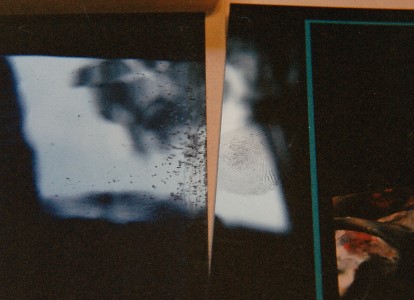 Photo 3
These two samples reflect overspray from a spray adhesive application (on the left) with a bold fingerprint (on the right). Both real no-no's.
Both types of Cibachrome will tolerate the heat of dry mounting though they are both susceptible to orange peel.
The polyester base Cibachrome will orange peel much more than the RC version and it should be remembered the smooth glass-like, high gloss finish achieved by the polyester is an extremely strong characteristic that should generally not be sacrificed. It too is the reason a higher degree of orange peel is visible when mounted permanently in any way.
So how do you answer to the questions concerning your client...yes it is probably a "type" of Cibachrome, a positive slide or transparency printed onto a resin coated paper using a positive/positive method. Since any well organized frame shop routinely uses sales aids to illustrate specific framing procedures, results and potential problems, show your client the samples of mounting polyester and resin coated photographs and make mounting suggestions in line with a routine RC photograph mounting. Remember to promote the use of conservation glazing in conjunction with light sensitive photographs even though the coloring process with Cibachromes is enhanced to a much greater degree.
All in all, the decisions to be made include whether or not to mount the photo, and by using which method. The best solution for mounting a polyester base print would be as you would any archival keepsake using proper conservation methods. Generally consider any resin coated RC photo (Cibachrome or otherwise) open game for wet, spray, pressure sensitive or dry mounting procedures, for contrary to their namesake "an RC Cibachrome by any other name is still an RC photo".
END
Copyright © 1994 Chris A Paschke
For more articles on mounting basics look under the mounting section in Articles by Subject.
Additional information on all types of mounting is found in:
The Mounting and Laminating Handbook, Second Edition, 2002,
The Mounting And Laminating Handbook, Third Edition, 2008 and
Creative Mounting, Wrapping, And Laminating, 2000 will teach you everything you need to know about getting the most from your dry mount equipment and materials as an innovative frame designer.
All books are available from Designs Ink Publishing through this website.
Chris A Paschke, CPF GCF
Designs Ink
Designs Ink Publishing
785 Tucker Road, Suite G-183
Tehachapi, CA 93561
P 661-821-2188
chris@designsinkart.com