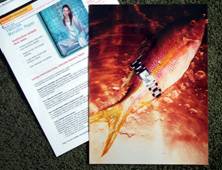
 Photo 1: Enduro Metallic Photo Paper
A new RC photographic paper from Kodak called Endure Metallic Paper hit the consumer market the first half of this year.
For years I have been using the December column to highlight and recap the most asked mounting questions of the past year. Since the onset of the digital revolution it has become more and more difficult to separate the two topics of mounting and digitals. Seems most questions and problems these past months have surrounded that very revolution. This year I planned on writing an article on mounting plain and simple, but as I began to pull together information to finalize my topic digitals and new products surfaced.
In recent PPFA Hitchhikers and PFM Grumble forums there has been extensive discussion about the identification, handling and mounting of digital photos. Seems they are still turning colors without warning and even the photo labs are not identifying digital processing to their customers when asked. At my next ISO meeting set this winter in Washington DC I have a number of framing issues I plan on bringing up to the digital committee. Hopefully I'll get more answers for you during that set of meetings. So in this article, there are two major issues; metallic photographs and cold roller laminators.
Fear of the Unknown
On The Grumble recently there was a discussion over laminating metallic photographs. When I think of a 'metallic' photograph I would naturally translate it into a metallic Mylar substrate or hologram. Responses to the inquiry seemed to echo my thoughts with don't laminate any metallic to try applying an acrylic sealer over it. Without knowing EXACTLY what the substrate or materials are, giving any advice can be very dangerous. There are indeed metallic photos out there, though they actually contain no metal at all.
Customers may have unrealistic ideas about what may be done to showcase their art, so it is always up to the framing professional to help guide them through the mine fields of their original concept of presentation to final display. Years ago we re-educated about the ills of hanging an oil painting over a fireplace, today it could be laminating a metallic photograph.
Kodak Enduro Metallic Photo Paper
New is a metallic photograph paper from Kodak released during the first six months of this year called Endure Metallic Paper (photo 1). It has obviously hit the market because of the plethora of questions and concerns about it over the forums. It has a glossy finish with a distinctive metallic appearance (photo 2).
Photo 1: Enduro Metallic Photo Paper
A new RC photographic paper from Kodak called Endure Metallic Paper hit the consumer market the first half of this year.
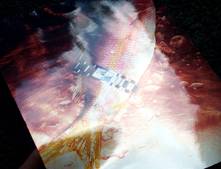 Photo 2: Reflective Metallic Finish
It is a high gloss reflective finish with a distinctive metallic appearance, as seen in this unmounted photo.
The metallic look of the paper is only a support feature accomplished by inclusion of something called micro voids in the base rather than actual metallic particles. Image stability and lightfastness of Endura Metallic Paper is excellent at 100 years in typical home display, 200 years in dark storage, but only 1-5 years in commercial display. It shares the same emulsion as the Kodak Supra Endura Paper and performs in similar fashion. Plus the paper is designed for both traditional and digital printing. It is compatible with Kodak and numerous other manufacturersdigital LED printers. This rises a bit of a red flag I agree.
Since traditional RC photos easily tolerate heat it would be an assumption that digital developing and printing would also tolerate heat. And in typical framer test applications of LED prints, so far, they have easily tolerated the heat tortures of dry mounting. Framers need to be aware of this paper because of its projected uses, distinct appearance, handling and tolerances. Expect to see these photo prints in all aspects of portraiture and social imaging including: senior portraits, sport cards, weddings, glamour shots, and special events of all kinds. Commercially the opportunities are endless as displays.
Heat Tolerance Testing
Basic preliminary testing of the photos were at temperatures of 150ºF, 175ºF, 195ºF using a Bienfang 210M-X mechanical press, a sheet of permanent ColorMount tissue adhesive, and Bainbridge 4 ply unbuffered photo board. The results showed no reactions to traditional mounting temperatures nor were there any indications to suggest use of cold mounting procedures might be advised (photo 3). The high gloss surface was also unaffected by any heat applications.
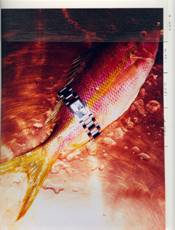 Photo 3: Heat Tolerances
Basic preliminary mounting of the photo at 150°F, 175°F, 195°F as noted along the right side of this sample including the laminated strip of 225°F at the top shows tolerances are extremely high. Allowing for average dry mounting temperatures to be used with these RC photos.
As a result of the initial heat testing it was then decided to test for higher temperature laminates. A single strip of Bienfang textured linen laminate was applied across the top of the mounted photo. The vinyl laminate was then mounted at 220ºF for five minutes using thick overlay foam and standard single sided release paper. The top edge of photo 3 shows the laminate which mounted beautifully.
Since the laminate was mounted to the dark area only it was difficult to tell whether it impacted the metallic appearance of the photo. In photo 4 a typical heat-set surface laminate used in picture framing was applied to challenge the metallic appearance of the photo, but there was still no change in the image (photo 4). Since the test laminate was the higher temperature Bienfang product, obviously lower temperature Drytac/Hot Press laminates will also be fine for these images.
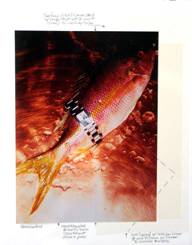 Photo 4: Laminate Testing
The arrows at bottom indicate the unmounted ⅓ at the left, traditionally mounted center using ColorMount and 4” wide gloss finish laminate down the right side of the photo. After initial mounting and laminating, the release liner was laid over the laminate lower right corner, and repressed to remove the typical texture created by the sponge.
Metallic Appearances
It was stated on one of the email exchanges that the metallic gloss would be damaged and/or lost if heat mounted or laminated. Reflections of the photo surface shows there has been no change to the metallic appearance of the photo even after temperatures of 220ºF for as long as ten (10) minutes (photo 5).
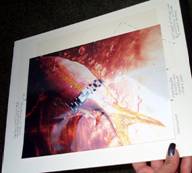 Photo 5: Metallic Stability
The reflections of the photo surface shows there has been no change to the metallic appearance even after temperatures of 220ºF for 10 minutes though the laminate has toned down the nearly wet appearance of the original photo gloss. Again, the metallic was not changed, the photo gloss finish was.
All around, they seem to react just like any traditional RC color photo to standard handling and framing practices, meaning they are susceptible to fingerprints and orange peel. Even though average dry mounting temperatures have no effect on Endura Metallic Papers, selecting a lower temperature adhesive such as Bainbridge SpeedMount will always aid in the control of other photo issues such as orange peel. Another note: solvent tests on surface emulsion using UnStik (UnSeal), Undo, and Bestine Thinner showed no damage when spot cleaning, but fingerprints were nearly impossible to remove.
Trading in Heat Mounting
As products and production changes with new technologies, so does the handling of artwork. When preservation took hold some ten years ago it was a matter of educating the public to the benefits of conservation and the need for preservation materials to protect their valued art. The same is now true with the digital revolution. Once again framers are challenged with educating our customers over new materials needed to best preserve and showcase their art.
Just asking them questions is not proving to be enough. More than once in the past few months I have been asked about melted, green photos that were stated by the developing lab to be standard traditional film photos. Remember from past articles, that although they came from film in a camera, they could still have been scanned into or developed using digital technologies, now making them officially digitals. Even lab technicians are fighting to learn the new information and 21st century technologies.
The problem is we cannot often tell the difference between the duck and the goose. They look the same; both have white feathers, a long neck, and webbed feet. And when it has been confirmed by the lab to be a duck, and we then treat it as we have all ducks for years using traditional heat feed methods, why are these confirmed ducks turning out to be geese after all? Because the lab personnel still are thinking all foul are fed the same, so it doesn't really matter. But it does. So what is the heat alternative?
If You Can't Stand the Heat
Roller laminators have been the mounting system of choice for the past 20 years in the photo, sign and reprographics industries, because of their cold mounting methods, but have not been actively exhibited nor available in the picture framing industry. I am not saying that heat dry mounting is to become a thing of the past, but cold rollers are becoming the obvious alternative.
For years the major companies I have consulted for and worked with have been asking the same question of me, 'what is going to happen with mounting when framing?', and for years I have been saying cold rollers, cold rollers. With the recent acquisition of Tullis Russell Hot Press by Drytac, I think we will finally be seeing more active promotion and availability of cold roller machines in the framing industry. There has been a serious need for them for a number of years now with very limited availability.
The concept of mounting rollers is like a wringer washing machine. It compresses the layers under pressure while moving between the rollers, so the air may be squished out the back as it is bonded together. Models may be bought with heat or cold options; individual temperature settings for the rollers; variable depths for board thicknesses; speed controls of pass-through; and pressure adjustments.
Average time and pounds per square inch (psi) are 3 feet per minute at 50psi. A standard vacuum press has an average or 12-15psi, while a mechanical press is 2-4psi. They may be manually operated or compressor controlled and are available up to 72" wide. They are aggressive and can be a bear to adjust, but when aligned properly are work horses. Prices will vary from low to high depending on width required, intended use, assorted bells and whistles.
The companies listed below are sources for roller machines and associated products. I sincerely hope to be seeing these companies at our shows and in our industry more and more.
The Customer is Always Right
The old adage about the customer always being right does not define the same as it did twenty five years ago. In fact with technology as it is today, sometimes no one may be right! It's getting tougher to tell the difference between right and wrong, particularly when additional players like professional photo labs and open edition publishers are not passing on the whole correct story. In their defense, however, it could be they just don't realize the information they are sending out is vital to the long term life of a given image. Education and communication is required from all sides, and between all parties: developer, consumer, framer and displayer.
In order for the technologies of today and tomorrow to not be the death of framers we need to listen and learn from each other. The ongoing questions we continue to ask will enlighten all those involved. Just keep looking for help, reading everything you can get your hands on, ask questions, and be patient.
It'll all work out I hope.
END
Copyright © 2003 Chris A Paschke
Resources
www.codamount.com—Coda, Inc.—New Jersey—201.825.7400
www.daige.com—Daige Inc.—New York—800.645.3323
www.drytac.com—Drytac/Hot Press—Canada—800.353.2883/USA—800.280.6013
www.gbcConnect.com—GBC Films Corp—Illinois—800.723.4000
www.reprotechnology.com—Repro Technology—Texas—936.529.4419
www.sealbrands.com—Seal Graphics Americas—410.379.5400
For more articles on mounting basics look under the mounting section in Articles by Subject.
Additional information on all types of mounting is found in:
The Mounting and Laminating Handbook, Second Edition, 2002,
The Mounting And Laminating Handbook, Third Edition, 2008 and
Creative Mounting, Wrapping, And Laminating, 2000 will teach you everything you need to know about getting the most from your dry mount equipment and materials as an innovative frame designer.
All books are available from Designs Ink Publishing through this website.
Chris A Paschke, CPF GCF
Designs Ink
Designs Ink Publishing
785 Tucker Road, Suite G-183
Tehachapi, CA 93561
P 661-821-2188
chris@designsinkart.com