Paschke Online
Designs Ink Publishing Article Archive and Reference Library
Articles by Chris A. Paschke, CPF GCF
"Hinge Basics"
November 2004
Preservation framing is designed to maintain and preserve the original value of the art being framed by using noninvasive materials and techniques. Whether original charcoal, pencil drawing, signed etching, limited edition, watercolor, photograph, or digital art, they should all be mounted using traditional conservation hinging techniques with Japanese papers and cooked starch paste, or preservation mounting alternatives.
Preservation mounting methods are those that allow the mounted artwork to be removed from the mounting having it return to its original unmounted state. This removal is known as being a reversible process. Accepted alternatives include commercial and hand constructed corner pockets, edge strips, and prepasted hinges, let's explore.
Archival Overview
The word "archival" has been bantered about in the framing industry, like acid free, for years. Archival is a word used to describe materials that are safe to use when preparing an item for long term storage and preservation. In framing, it refers to the relative permanence or longevity of a given material and its ability to remain stable over time. Hence, we assume that when manufacturers use the term archival in their advertising and naming of products they are being true to the above description.
Only true archival hinging materials should be used when preservation framing. That includes mounting strips of 100% cotton rag paper; Mylar and polypropylene edge strips and pocket corners; dry Japanese prepasted nonsticky tapes; rice and wheat starches in powder form; prepared commercial powers that activate with water but do not need cooking; Japanese hinging papers of assorted weights; burnishing bones, blotters and drying weights.
There are many manufacturers and distributors for hinging materials, while only a few will be mentioned here. Check all sources when shopping for preservation materials.
Pressure-Sensitive Adhesives
Conservation techniques involve starch pastes, but there are also pressure-sensitive and gummed materials that may be used in the preservation package. A pressure-sensitive adhesive is a permanently tacky substance that bonds to an untreated surface at room temperature, by only the application of slight pressure. Pressure-sensitive materials for preservation hinging include corners, strips, and tapes and may also called self-adhesive tapes, P-S tapes, or PSA adhesives.
P-S adhesives are in a constant active phase, making them less stable than starch, or even gummed materials. They bond to 25% of their full capability with only thumb pressure and should be burnished to be thoroughly activated. Even though acrylic based p-s adhesives are considered reasonably stable, slipping can occur if the hinged item is heavy, or if temperatures and humidity levels are high.
Since acrylic p-s bonds may become more aggressive over time and the plasticizers and tackifiers can migrate into RC photos, acrylic paintings, and assorted synthetic materials which can be a problem long term. Chemical reactions can occur between the adhesive and plastics based art images developing cold-flow (cold-creep, or cold-crawl) which allows the adhesive to aggressively melt around fibers of the artwork making removal very difficult.
P-S in Preservation
Pressure-sensitive adhesives used in conjunction with preservation mounting techniques should never come in direct contact with fine art as hinges. ArtSaverArchival Mounting Strips; Lineco Archival Mounting Corners, Mylar Photo Corners, and Polypropylene Framers Corners; and See-Thru polyester Mounting Strips make up a few of the available pressure-sensitive archival edge strips and corner pockets acceptable as preservation applications (photo 1). Since these p-s adhesives are inert they will not harm a conservation package and since they are not in direct contact with the art they remain safe to use.
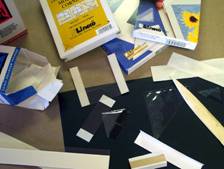 Photo 1
Clockwise from upper left: ArtSaver Archival Mounting Strips; Lineco Archival Mounting Corners, Mylar Photo Corners, and Polypropylene Framers Corners; See-Thru polyester Mounting Strips and bone burnishers make up a few of the available pressure-sensitive edge strips and corner pockets.
Though p-s paper tapes are not suggested for preservation mounting, they might be used for easily replaceable images, short term display, or artwork not considered valuable, including: open edition reproductions, poster art, some photographs and items sensitive to water such as inkjet digitals. Pressure-sensitive tissue tape is the closest thing to traditional cooked starch and torn tissue hinges without moisture, while still being a ready-to-use, acid-free, neutral p-s tape. Assorted weights and tapes allow for selecting the right strength for any application (photo 2). Linen tapes, regardless of pressure-sensitive or gummed, should never be used to hinge any art. They are perfect for long side book hinges (flange hinge) that attach the window mat to the backing board.
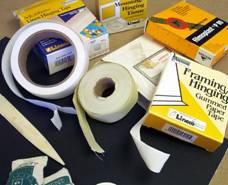 Photo 2
Both P-S and gummed linen hinging tapes may be used for attaching window mats to the backing boards, while P-S and gummed paper tapes are designed for the hinging of art. Assorted weights and types of tapes allow for selecting the right strength for the art. Lineco, Neschen, University Products, and NielsonBainbridge included in photo.
Gummed or Water Activated Adhesives
Water activated or dry gummed and tape adhesives are made from animal, vegetable, or mineral sources. Of those, only vegetable starch pastes should be used in preservation hinging. Gummed tapes are preferred by conservators to pressure-sensitive tapes in framing because of their easier removal with water, and their long term hold regardless of temperature and humidity fluctuations.
Vegetable Starches
Vegetable-based starches free of gluten are the adhesive of choice for preservation hinging, such as rice and wheat starch. These are available in numerous versions from ready to cook powder form to precoated Japanese paper strips. Nori, is a precooked, prepackaged, ready-to-use, wheat starch containing no preservatives (photo 3). There is a precooked version called Zen Instant Wheat Starch which is are water soluble, freeze dried crystals which mix into a non-staining, reversible, pH neutral paste.
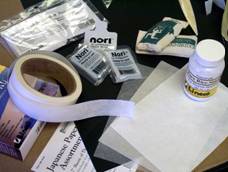 Photo 3
There are commercial gummed and pre-pasted tapes; dry rice and wheat starches ready to cook; and powders that require no cooking. Assorted rice papers allow for the correct fiber strength to allow the hinges to remain the weakest link in the hinging process. Weights, blotters, and burnishing bones are all frequently used items when traditionally hinging artwork. Lineco, NielsonBainbridge included in photo.
There are also starch saturated, predried, water soluble tapes or strips such as Insta-Hingesand HayakuJapanese Hinging Paper. Both are neutral pH, reversible products that only need to be moistened to activate their adhesive. The best way to saturate a dry tape is to allow moisture to wick up into the hinge from a soaked blotter beneath rather than to brush water onto it. The abrasive action of moist brushing serves to remove some of the adhesive thus weakening the potential bond.
Traditional Hinging Materials
Japanese hinging uses only noninvasive, reversible starch adhesive in conjunction with a lightweight Japanese rice papers. Hinges need to be light but strong, and since rice papers are made from long fibers this allows for a strips to be wet separated and feathered when creating them. This feathering helps prevent a ridge from developing where the hinge meets the art after pasting.
The hinge should always be the weakest link in the hinging process which is why there are a series of available papers used in hinging and an assortment of hinging techniques. Pick your hinging papers accordingly. The best hinging papers are handmade of 100% kozo fibers in variable weights including: mulberry (heavyweight), kizukishi (medium weight), toso tengujo and kozogami tsuru (lightweight). It is the duty of the hinge to tear before the art tears if the frame were to fall from the wall.
Corner Pockets and Folded Strap Corners
Corner pockets are a way of conservation mounting where there is no adhesive of any kind coming in contact with the artwork. As already established they may be commercially purchased or they may be simply constructed of rice paper strips and mounted using starch pastes (photo 4). The photo sampler shows two corners that have been constructed with mulberry paper. The upper left version is a small ½" x 2" piece of torn paper that was moistened with water for wet pulled fiber separation. Then fold the strip to form a ½" x 1" triangle corner that is glued to the 4 ply backing board with starch paste (diagram 1). This is the same basic construction as a Lineco Self-Folding Corner made of Mylar polyester with p-s adhesive seen in photo 1.
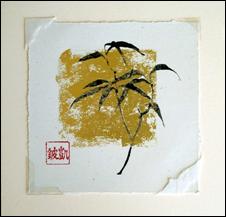 Photo 4
Corner pockets may be commercially manufactured of Mylar or polypropylene, or handmade of rice paper strips. Clockwise from upper left is a folded mulberry corner pocket; Lineco Mylar Photo Corner; ½" handmade mulberry folded strip; and polypropylene cut away pocket.
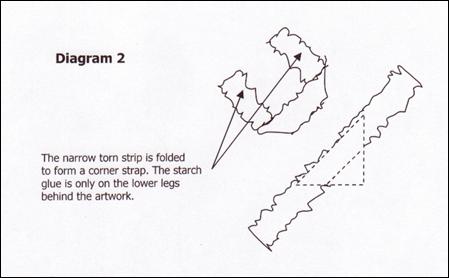
The lower right corner is an open strap of mulberry paper torn ⅜" x 2-½" and folded as in diagram 2. A strap corner supports a greater portion of the art corner for better support on larger images, and less likeliness for damage. This type of hinge can also be integrated into the actual frame design as when floating the art (photo 5).
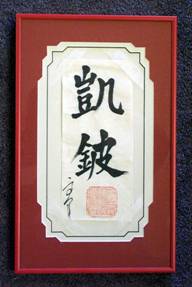 Photo 5
This piece originally framed in 1985 shows modified strap corners that hold the rice paper calligraphy floated. The straps are then held beneath the edges of the inner mat rather than glued.
Open Strap Corner
The small original Chinese calligraphy (5" x 12"), framed in 1985, shows modified strap corners that hold the rice paper calligraphy floated in the center of the window mats. The straps were not folded back creating pockets, but rather are held beneath the edges of the inner bottom mat then glued in place. Because this is a very lightweight piece of thin rice paper the unfolded straps have held and the art has not shifted, even after two cross country moves. But for art with any weight these supports should be folded strap corners.
The problem with using heavier commercial corner pockets made of polypropylene is their inherent strength that could dent or tear the corners of the art if it fell. Mylar corners are thinner and more likely to split than some of the heavier plastic corners, perhaps making them a better choice. Edge strips could also hold to aggressively rather than giving way, which could cause the art to bunch at their side contact points.
Basic Pendant Hinge
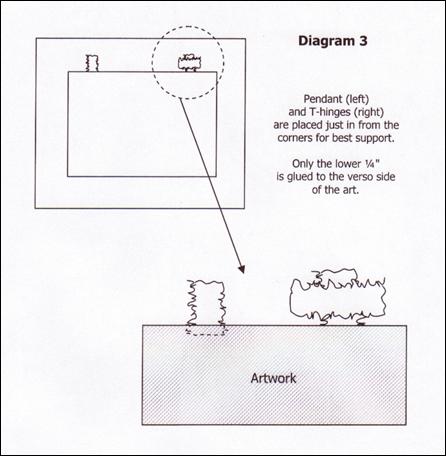
The most basic and frequently used preservation hinge is the pendant hinge. Small feathered strips of rice paper have been moistened and wet separated leaving the long fibers pulled at all edges. Lay the hinge on a scrap of 4 ply rag and brush starch glue along the bottom ¼" (one quarter inch) of the hinge. Let it set a moment for the initial shine of the paste to dry away then align along the top back (verso) side of the art.
Burnish the wet hinge with a clean brush or burnishing bone to smooth, press out air and feather edges of the hinge. Place a small 3x3" piece of spun polyester (Pelon) over the moist hinge, then a 3x3" dry blotter followed by a weight. The Pelon prevents the blotter from sticking to the hinge while drying. It should be allowed to dry about an hour depending on humidity conditions.
After the hinge has dried, the remaining hinge portion is then adhered, weighed and dried as above to the 4 ply backing board. A small unglued portion of the original pendant hinge allows the art to hang freely and the Japanese paper hinge would be allowed to tear if the frame were to fall to the floor (photo 6). Pendant hinges are used when a window mat will be covering and additionally supporting the hinged art around all sides.
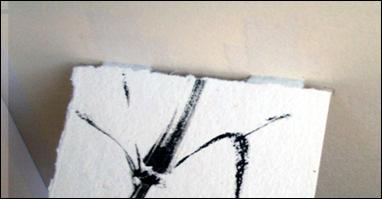 Photo 6
The small 5X7" original is hinged with large mulberry paper strips attached with cooked starch paste to the upper ⅛" (one eighth inch) of the back, then reinforced with a cross piece for demonstration purposes. This is considered a reinforced Pendent Hinge.
Hinge placement across the top of the art varies depending on the size and weight of the image, but the outermost hinges should begin a little more than one width (not length) of the hinge from the edge of the art. Additional hinges might be needed at 12-15" intervals.
T-Hinge
A T-hinge is a reinforced pendant hinge. These are the strongest hinges which give the most support to the art. The base of the T-hinge comes in contact with the back side of the top edge of the art image like the pendant, and then a second piece is applied horizontally across the face of the first piece (diagram 3).
The horizontal T portion of the hinge may be crossed farther away from the art than shown in the photo to allow for greater flexibility of the art during expansion and contraction if that seems to be a serious a consideration. Remember that allowing for hinge and art flexibility will never work if the mats and filler boards are compressed too tightly into the closed frame.
When creating T-hinges any pressure sensitive paper or linen tapes could technically be used. They are there to reinforce the original pendant portion, never come in contact with the art and would be discarded with the backing board if ever separated from the fine art.
END
Copyright © 2004 Chris A Paschke
For more articles on mounting basics look under the mounting section in Articles by Subject.
Additional information on all types of mounting is found in:
The Mounting and Laminating Handbook, Second Edition, 2002,
The Mounting And Laminating Handbook, Third Edition, 2008 and
Creative Mounting, Wrapping, And Laminating, 2000 will teach you everything you need to know about getting the most from your dry mount equipment and materials as an innovative frame designer.
All books are available from Designs Ink Publishing through this website.
Chris A Paschke, CPF GCF
Designs Ink
Designs Ink Publishing
785 Tucker Road, Suite G-183
Tehachapi, CA 93561
P 661-821-2188
chris@designsinkart.com