In this day of constant concern over drought in various parts of the country, and the desire for clean water, there is one place that droplets of water (clean or otherwise), steam or moisture of any kind is extremely undesirable...and that is during the course of dry mounting!
As I've mentioned before and will continue to review, the four keys to successful mounting are TIME, TEMPERATURE, PRESSURE and the topic of this article MOISTURE. "Moisture" is quite easily controlled and by doing so you will ensure repeatedly well executed, smoothly mounted projects, as long as the other three elements are also always addressed. Make sure the "time" is correct for the thickness of the materials being mounted, the "temperature" is set to accommodate the type of adhesive being used and that the "pressure" of the press is correct for the above materials.
Consider for a moment the frustration of attempting to attach a postage stamp to a damp envelope. Even though the adhesive on the back of the stamp and the catalyst of licking the stamp to activate the adhesive are both there, the stamp still will not stick. The similar result of poor fusion may occur if you attempted to dry mount a poster with the proper adhesive at the correct time, temperature and pressure...yet air bubbles occurred under the mounted poster simply because there was moisture remaining in the selected substrate.
Procedure
Predrying materials is a very simple process and a mandatory practice to get into when mounting any sized project, when using a Seal Mechanical Press of any size. I will address the issue and options of predrying in vacuum presses a little later. By removing the moisture from within the board prior to mounting, the adhesive is allowed to readily fuse to the substrate such as a moistened stamp to a dry envelope. Note also that pressure is always applied to that stamp too, so very similar theories of mounting apply for any good bond.
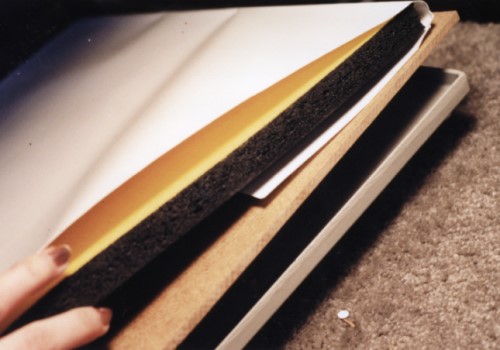
Use a clean piece of absorbent Kraft-type paper folded in half as an envelope, and place the artwork or material to be mounted into the envelope then into the press for 15-30 seconds. The press should have been pre-adjusted to the proper pressure for the substrate to be mounted and closed, but need not be locked during this process. The substrate also needs to be predried prior to mounting. Do not attempt to predry using a release paper envelope, as opposed to Kraft paper, because the moisture has nowhere to go and is merely trapped or turned to steam.
Exception to the Rule
It has been said that foam boards need not be predried for use in a mechanical press because of the inert nature of the inner foam not wanting to absorb moisture. I tend to agree with that theory when discussing the clay coated regular foam boards, but the more toothy nature of acid-free foam boards may very well absorb some degree of moisture. If you develop the habit of regularly predrying your materials, it will become second nature and the possibility of moisture problems arising will be eliminated entirely from your mounting worries. This is the correct method of preventative mounting...don't short cut, do it right from the beginning.
Reinforcing good habits by repeated successful mountings will ensure your confidence and reputation.
The basic humidity level varies throughout the country and obviously the moisture issue becomes much greater a problem in high humidity areas. Think about where you work and the storage of your mounting boards. If you use a dehumidifier in your store during high humidity months, yet boards are stored in the basement, the moisture problem in the board will still exist and may be greater than you realize. Fabrics notoriously absorb a great deal of moisture as well as boards, and often when materials feel cool to the touch it is a good indicator of moisture content. Even in regions where humidity is generally not an issue (perhaps Redding, CA), predrying when using a mechanical press is a must.
Another issue to address is the time frame surrounding predrying. You can't predry the entire mounting pile on Monday for processing on Friday...the boards will most likely reabsorb moisture during that time. Use common sense! It would be best to predry just prior to mounting each time. If you create the habit of predrying in your step-by-step process, just as weighting the completed mounting during cooling, you've reinforced a positive process of mounting.
Vacuum Presses
In opposition to the mandatory procedure of predrying when using a mechanical press, the vacuum principle of drawing the air from within the press precludes this step when using a hot/cold vacuum press of any kind. Although it is not a mandatory step, I feel that once again in high humidity regions of the country it is better to be safe than sorry. I often predry materials I plan to vacuum mount simply to ensure control of all the possible variables, especially since I moved to Connecticut.
All the elements of successful and profitable mounting are very simple to understand. Control the time, temperature, pressure and moisture elements of each project and you will achieve the success. By creating perfect and predictable mountings each time with no mistakes you can only make more money...because once again "time is money".
END
Copyright © 1992 Chris A Paschke
For more articles on mounting basics look under the mounting section in Articles by Subject.
Additional information on all types of mounting is found in:
The Mounting and Laminating Handbook, Second Edition, 2002,
The Mounting And Laminating Handbook, Third Edition, 2008 and
Creative Mounting, Wrapping, And Laminating, 2000 will teach you everything you need to know about getting the most from your dry mount equipment and materials as an innovative frame designer.
All books are available from Designs Ink Publishing through this website.
Chris A Paschke, CPF GCF
Designs Ink
Designs Ink Publishing
785 Tucker Road, Suite G-183
Tehachapi, CA 93561
P 661-821-2188
chris@designsinkart.com