 Photo 1
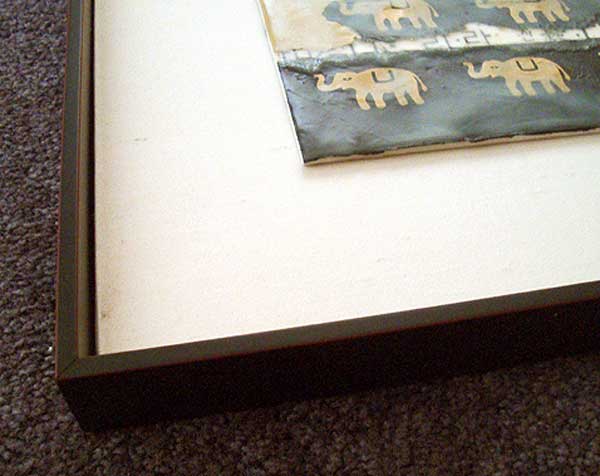
Encaustic art applied to 8-ply rag board has been mounted with silicone adhesive to the center of a linen wrapped foam center board. The mounted art was then mounted with more silicone adhesive to the edges of a short base float frame.
Last month I discussed the use of silicone release papers to protect the surface of your encaustic works. Just this past week I was tasked to remove an encaustic original on 8-ply rag board that had been mounted to a linen wrapped foam center board and fitting into a short base float frame (photo 1). I will cover the difference between short base and long base float frames in an upcoming column.
Photo 1
Encaustic art applied to 8-ply rag board has been mounted with silicone adhesive to the center of a linen wrapped foam center board. The mounted art was then mounted with more silicone adhesive to the edges of a short base float frame.
The art had been mounted to the linen with clear silicone adhesive, which held it very well, however silicone is known to seep oils over time and it is never supposed to be used in conjunction with any original art…including encaustics. In order to remove of the art from the linen the back layer of rag paper had to be torn from the board (photo 2). Even though tearing any layer of the 8-ply rag is not advised practice, in this case the removal of the silicone from the back of the art by removing that silicone saturated layer will most likely save it from future damage.
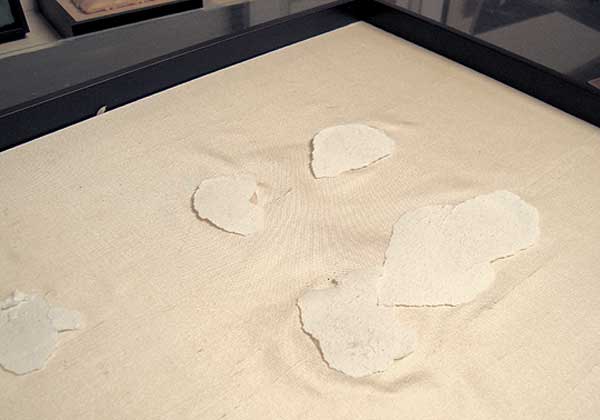 Photo 2
Removal of the art from the linen caused the back layer of rag paper to be torn from the paper substrate. Though the process lost the back layer of paper it also cleaned the art of all silicone residue thus protecting it from later silicone damage.
Solvents and Such
There are many types of adhesive solvent on the market, and all are caustic to touch and breathe. Acetone is a familiar solvent, as well as naphtha, xylene, and toluene, all of which are available at Home Depot. Commercial low odor formula OOPS! is an affordable blend of the above that dissolves many household irritants. OOPS! was the solvent of choice for this project.
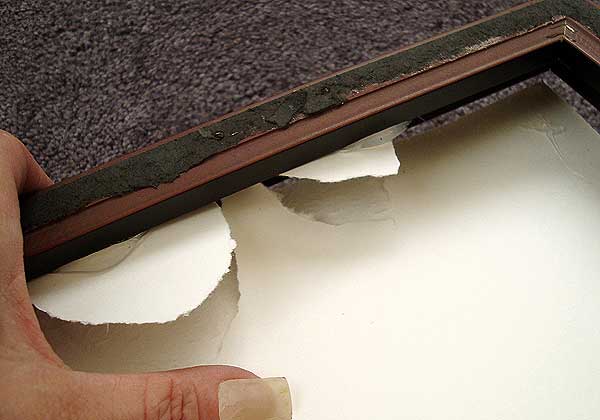 Photo 3
To salvage the frame the adhered linen wrap needed to be removed and the silicone residue had to be dissolved.
Just as it did with the art, the silicone held the linen backing to the frame very well, but all framing should be removable for future care of any original art. When the glued backing was torn from the frame without any solvent the silicone tears leaving large chunks of backing board stuck to the frame (photo 3). By saturating the dried silicone with solvent the silicone is softened and easier to remove from the inner base of the frame (photo 4). After a five to ten minutes a fairly blunt bamboo scraper was used to get under the globs of adhesive and scrape it off the frame (photo 5).
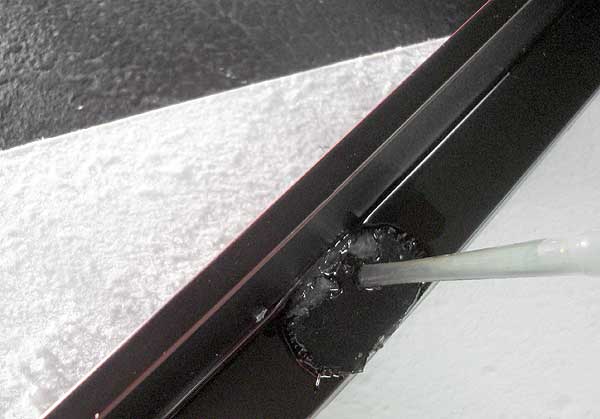 Photo 4
An eyedropper full of OOPS! was spread along each side of the frame, then additional solvent was applied to each blob of silicone.
 Photo 5
After a few minutes a bamboo scraper is used to get under the dried silicone to scrape it from the frame.
Frame Salvage
It took a few more coats of solvent to best clean the frame for reuse. The removal of the adhered art and backing had stressed the corner joints of the frame so it required reinforcement and additional touch
up to make it once again artist ready. After all frame repairs were completed a new 15½" x 15½" platform of ½" birch was fitted to this 16x16" frame using screws and eyes from the back. It is now ready for a new completed encaustic work on 8-ply rag board or ¼" Baltic birch panel to be glued using Titebond Wood Glue to the surface of the float frame platform (photo 6).
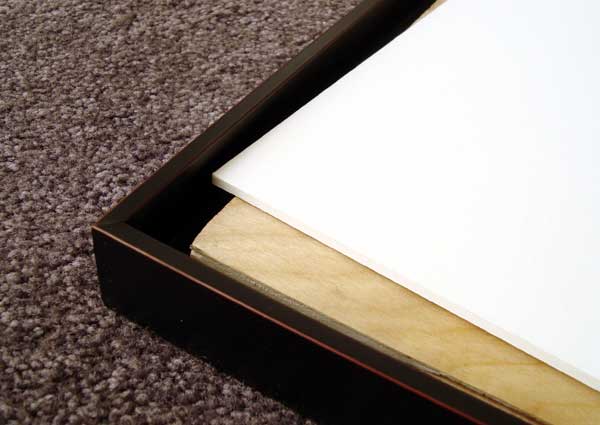 Photo 6
Once the frame is cleaned a new ½" birch platform is attached with screws to the back of the frame as the new base. The 8-ply rag—or ¼" wood panel—may now become a new encaustic masterpiece that will be mounted to the new platform float frame.
So why is it acceptable to use wood glue in framing and not silicone? Silicone is a very aggressive adhesive it is not well suited to use in framing. It outgases which can contaminate and leave a haze on the inside of the glass of a sealed frame package and its petroleum based oils will seep out over time saturating whatever is in contact with…including paper, board and wood All in all, not a good adhesive around art.
Moral of the Story
This encaustic masterpiece lived to tell many more tales over the years in a newly created sink mount frame—a future column here too—and the remaining frame has been fitted for a new project. All original and valuable art should be framed so it may be removed at a later date if necessary. Make certain your custom framer understands what encaustic art is all about and stress that you do not want it glued into the frame. Custom framers are learning how to handle encaustics right along with you, and I am doing my best to teach them as fast as I can. As always…I'm here to help.
END
Copyright © 2009 Chris A Paschke
For more articles on mounting basics look under the mounting section in Articles by Subject.
There is a special section in the library for all past IEA Framing Matters articles from Wax-On!
Additional information on all types of mounting is found in:
The Mounting and Laminating Handbook, Second Edition, 2002,
The Mounting And Laminating Handbook, Third Edition, 2008 and
Creative Mounting, Wrapping, And Laminating, 2000 will teach you everything you need to know about getting the most from your dry mount equipment and materials as an innovative frame designer.
All books are available from Designs Ink Publishing through this website.
Chris A Paschke, CPF GCF
Designs Ink
Designs Ink Publishing
785 Tucker Road, Suite G-183
Tehachapi, CA 93561
P 661-821-2188
chris@designsinkart.com