
It may seem to most artists that framers have a language of their own, so I thought it might be a good time to pass on a little framing vernacular. Though many of us frame our own encaustic masterpieces we occasionally do need the help of an expert framer, and understanding their terminology makes it far easier to communicate your needs and desires.
I have a feature article coming out in The Pastel Journal, May 2010 called over this very topic, but from a pastel artist point of view.Many of the same terms translate into encaustic, though it is important to understand the basic connotation of these commonterms to better understand what is actually being suggested when framing your art.
Acid Free: A chemistry term used for materials 7.0 + 5% on the pH scale of 0-14, that are nonstaining and nondeteriorating when tested, but this can change over time.
Acid Neutral: Any inert material with a natural unbuffered pH above 7.0 with no added alkaline reserve.
Acrylic Sheeting: A chemically stable copolymer plastic sheet PMMA [poly (methyl methacrylate)], polystyrene, or polycarbonate used in framing as glazing, a mounting substrate, or to build showcases. Sheets are available that have been enhanced with UV-inhibitors, scratch resistance, and reduced reflection treatments.
Archival: A non-technical term used to suggest a material, technique or process is permanent, durable, and stable over time, as would be used in a museum or archive. When the term is used in marketing it may also be used to mean lightfast.
Bevel: The slanted angle cut on the inside edge of a window mat.
Buffering: The addition of calcium carbonate during papermaking as an alkaline reserve, which raises the pH level to counteract acidic contamination.
Float Frame (aka Floater Frame): A frame that allows the art panel or cradle to appear to be hovering within the border of the frame.
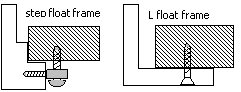
Fome-Cor: A specific name brand of foam center board manufactured by Alcan Industries. Foam boards should be referred to as such and not by their brand name.
Foam center board: The generic term for backing and filler boards with a foam center with assorted face papers such as 100% cotton, neutral pH (AF), and clay coat, available in white and black.
Fugitive: Inherently unstable materials or media that easily and quickly fades, especially when exposed to visible or UV light. Fading is the loss of brightness or brilliance — of line, color or form.
Glazing: The clear sheet of glass or acrylic used to protect the front of framed art.
Laminate/Laminating Film: A heat-activated, scratchproof, waterproof, washable vinyl or polyester film developed for use as a glass substitute. It may be applied to window mats so use of glazing is not necessary.
Lightfast: The ability of a medium or material to withstand exposure to UV (daylight) without fading or color shift.
Museum Quality: Materials that are inert, stable, and suitable for housing art and artifacts as would be used in a museum. Also referred to as museum treatment.
Museum Mounting: Use of reversible hinges, corner pockets or edge strips to mount the art to a 4-ply cotton rag backing board.
Plexiglas (aka Plexi): Is a trademarked brand name for a clear sheet of (PMMA) poly (methyl methacrylate). Acrylic is a family of chemically stable polymers.
Preservation Framing: Only reversible methods and neutral, stable, inert materials are used in all aspects of framing and selected techniques, from glass to dust cover.
Rag Board (rag mats, museum board): Mat board made of cotton linters containing alkaline reserve.
Reversible: Materials and techniques that may be undone without altering the art in any way thus returning to its original condition.
Reverse Bevel: An invisible bevel cut to the inside of the mat window.

Sink Mount: A foam border that surrounds a panel or wax soaked paper topped with a window mat that holds it in place.

Spacer: A layer of foam center board, 4 or 8-ply rag board, or commercial extruded polyester strip that separates layers and adds depth.
There is a learning curve any time a new concept or medium is emerging, and education goes both ways. Never hesitate to help educate your framer about your needs and desires, and in turn allow them to help teach you about framing alternatives…or you can always call me.
END
Copyright © 2010 Chris A Paschke
For more articles on mounting basics look under the mounting section in Articles by Subject.
There is a special section in the library for all past IEA Framing Matters articles from Wax-On!
Additional information on all types of mounting is found in:
The Mounting and Laminating Handbook, Second Edition, 2002,
The Mounting And Laminating Handbook, Third Edition, 2008 and
Creative Mounting, Wrapping, And Laminating, 2000 will teach you everything you need to know about getting the most from your dry mount equipment and materials as an innovative frame designer.
All books are available from Designs Ink Publishing through this website.
Chris A Paschke, CPF GCF
Designs Ink
Designs Ink Publishing
785 Tucker Road, Suite G-183
Tehachapi, CA 93561
P 661-821-2188
chris@designsinkart.com