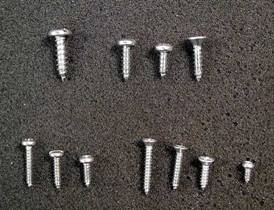
 Photo 1
Top row: Round head #8x¾"; Pan head #6x½", #6x⅜"; Flat head #6x⅝". Bottom row: Round head 4x⅝", 4x½", 4x⅜"; Flat head 4x¾", 4x⅝" 4x⅜"; Round head tiny #3x¼"
I realize understanding hardware is something all framers should already have a grasp of, but there is nothing wrong with a few tips and a little basic terminology for clarificarion.
Screws fall into a category of hardware correctly known as fasteners. Since nails and tacks can pull out of wood for lack of grip, the threading of a screw can hold much more secure. That said, there are some of the same issues with screws that were covered in my May 2011 column "Off With Their Heads" — when discussing screw eyes. In soft wood—pine, reconstituted wood, MDF—threading may create sawdust rather than grabbing wood grain which allows a stressed screw to pull out with time and gravity. Screws can also stress the sides of the frame where they are inserted by weakening wood narrow frames, so multiple screws and steel hangers should be used.
Shaft Weight or Gauge
Though the professional numbering system for fasteners may be rather confusing—based on dimensions and threading—smaller screws have been simplified by an industry number designation preceded by the # sign. These numeric sizes are shaft diameters that have been standardized based on sizes commonly in use in the hardware market. These do not show a number of threads-per-inch designation and run from #0 through #15, with #0 the smallest and #15 the largest. — In framing #4, #6 or #8 are most common, with #3 and #10 occasionally needed (photo 1).
Photo 1
Top row: Round head #8x¾"; Pan head #6x½", #6x⅜"; Flat head #6x⅝". Bottom row: Round head 4x⅝", 4x½", 4x⅜"; Flat head 4x¾", 4x⅝" 4x⅜"; Round head tiny #3x¼"
Types of Fasteners
For our purposes screws are identified and selected by shaft # (#3, #4, #6, #8); category (Wood, Metal, Machine); head style (Flat head, Pan head, Round head); and drive (Phillips, Slotted, Combination). Wood screws have a smooth shank at the top with a tapered point for easy insertion. Metal screws—aka sheet metal screws—are fully threaded head to point. — By selecting fully threaded shafts there is more bite to the screw for use in framing (photo 2). Though there are many head styles with flat head, pan head, and round head being most common for framing. Flat head screws are chosen when countersinking so the head is flush with the wood surface leaving nothing protruding (photo 3). Round head screws have a domed shape, while pan head screws have a slightly rounded head with short vertical sides (see photo above). Pan head or round head are most common for D-rings, D-straps and steel plate hangers.
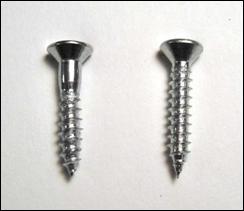 Photo 2
Wood screw with no threads at top (L), metal screw is threaded full length(R).
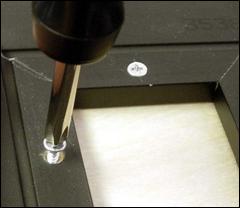 Photo 3
Flat head machine screw countersunk to be flush with back of float frame.
Drive configurations are numerous but straight slotted, Phillips and combination are shown here. Slotted drive is traditional and what is installed with a standard flat screwdriver. The combination drive—aka cross slot—was originally designed for the Phillips screwdriver and some of the foreign screws are still of this design, where only a Phillips type screwdriver should be used. Hardware purchased out of Canada often has the combination drive pattern.
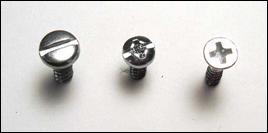 Photo 4
Slotted drive, pan head (L), Combination drive, pan head (C), Phillips drive, flat head (R).
Matching the correct screw shaft #, head, and drive can greatly simplify installation. Phillips seem less likely to slip than a slotted screw and tiny #3 round head screws best hold a small sawtooth hanger. The smaller #4 and #3 Phillips head often require a smaller PH#1 screwdriver or electric driver tip for installation rather than the usual PH#2. Using too large of a driver may strip the drive head. Stocking twelve different sizes of screws may sound like a lot until you realize that there are four different shaft weights with a variety of lengths and drive patterns—all of which do serve a specific need.
I stock mostly Phillips or combination drive, flat and pan head style screws, #4 and #6, in lengths from ⅜" to 1", and with very little investment I am ready for almost anything. Yes I do have a tiny #3 and a few #8, but they aren't called for often. At deadline time when all that is left is the fitting and hanging hardware—don't be left wishing you had ¾" #4 flathead for that float frame when all you have is a ⅝". Yes, ⅛" can make a difference!
END
Copyright © 2011 Chris A Paschke
For more articles on mounting basics look under the mounting section in Articles by Subject.
Additional information on all types of mounting is found in:
The Mounting and Laminating Handbook, Second Edition, 2002,
The Mounting And Laminating Handbook, Third Edition, 2008 and
Creative Mounting, Wrapping, And Laminating, 2000 will teach you everything you need to know about getting the most from your dry mount equipment and materials as an innovative frame designer.
All books are available from Designs Ink Publishing through this website.
Chris A Paschke, CPF GCF
Designs Ink
Designs Ink Publishing
785 Tucker Road, Suite G-183
Tehachapi, CA 93561
P 661-821-2188
chris@designsinkart.com