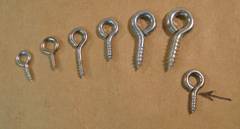
 Photo 1: Screw Eyes
Regardless of lightweight short shaft (L) or heavy duty long shaft (R) the eye is only as strong as the neck between the threads and the eye marked with the arrow.
Screw eyes, also known as eye hooks or eye screws, are designed as an all in one piece of hardware which screws into the back of the frame sides for attaching wire, and although many artists feel rather secure when using them they are not much better than a sawtooth hanger.
There are many reasons for reconsidering use of eyes.
Photo 1: Screw Eyes
Regardless of lightweight short shaft (L) or heavy duty long shaft (R) the eye is only as strong as the neck between the threads and the eye marked with the arrow.
Proper Installation
They should be installed about ⅓rd down the back side of the frame on either side. Mark your point and drill a pilot hole or make an indentation with an awl, install the eye and add the wire. There is most definitely a right and wrong way to add wire and next month I will cover weights and variations of wire. Many people live under the misconception that the setting of hardware in the exact location either edge of the backside of a frame will insure level hanging, but the only thing it does is creates even tension on both sides of the frame. Use of two hangers—rather than one—will distribute the weight and allow for more horizontal balance.
Alternatives
It is unlikely a small, lightweight 6x6" encaustic piece will ever have issues with eyes, but something 24x24" with the added weight of wax can definitely stress a traditional frame. If an unframed cradle or panel with float frame are used there is less likeliness eyes will be selected as the hardware of choice.
Today the most used framing hardware is the D-ring. It lies flat and although is screwed into place there is no stress point as the neck of a screw eye. They may be mounted at the proper angle for the wire or vertically to be hung directly on the wall mount for very heavy art.
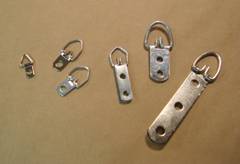 Photo 2: D-Rings
D-rings come in a variety of sizes from the tiny ¼" (L) to the mirror hanger heavy 3" version (R).
END
Copyright © 2011 Chris A Paschke
For more articles on mounting basics look under the mounting section in Articles by Subject.
There is a special section in the library for all past IEA Framing Matters articles from Wax-On!
Additional information on all types of mounting is found in:
The Mounting and Laminating Handbook, Second Edition, 2002,
The Mounting And Laminating Handbook, Third Edition, 2008 and
Creative Mounting, Wrapping, And Laminating, 2000 will teach you everything you need to know about getting the most from your dry mount equipment and materials as an innovative frame designer.
All books are available from Designs Ink Publishing through this website.
Chris A Paschke, CPF GCF
Designs Ink
Designs Ink Publishing
785 Tucker Road, Suite G-183
Tehachapi, CA 93561
P 661-821-2188
chris@designsinkart.com