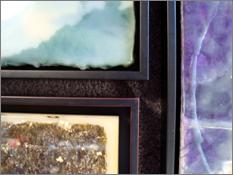
 Photo 1
Top left is deckle drip with uneven float space. Bottom left is a 1" pour with clean edges but uneven surface. Right side is smooth uneven edges with more even space.
The float space is the gap—or void—between the inner edge of the frame and the rigid canvas, cradle, or panel artwork (diagram 1). The float depth—or recess—is the distance from the top of the frame to the art.
Traditional placement of a canvas in a floater is 1/16" to ⅛" beneath the face of the frame with a ⅛" float space between the art and the side of the frame. The float space for encaustic art is far more flexible and variable depending on the art and the illusion being created. There is no right or wrong when it comes to encaustic and float spaces. A tight float space might be perfect for a poured piece with no wax on the edges, while a deep gallery wrap or 2" cradle might look better with a full inch float space.
Float Space
Although a canvas may only be ⅛" from the inner frame edge, encaustic surfaces and edging will dictate the type of float frame and the distances required for the float space and float depth (photo 1). Deckle drip wax edges may be very uneven and usually a simple narrow face, black float may be the best choice (photo 2). The edges of a banded pour are generally clean and square and the contrast between the inner hard edged square and the negative space of a wider float space often accents the art (photo 3).
Photo 1
Top left is deckle drip with uneven float space. Bottom left is a 1" pour with clean edges but uneven surface. Right side is smooth uneven edges with more even space.
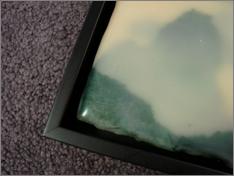 Photo 2
Deckle drip wax edges are uneven and will vary the float space. A plain, simple black frame may best enhance this type of art.
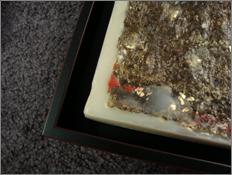 Photo 3
A wider float space better enhances the clean edges of a pour.
Float Depth
How deep is deep enough? Traditional stretched canvas recesses—the distance from the frame face to the art—are 1/32" to ⅛" (photo 4). If the depth is to be ⅛" it must be aligned and measured from the highest point on the surface of the art. Pay attention to all areas of the wax or paint. For encaustic paintings float depth may be anything from ⅜" to 1" depending on the size of the panel and the floater frame. Though face recess is often greater for encaustic than for canvas, in either case it must be deep enough to protect the full surface of the art if the frame were laid face down on the table.
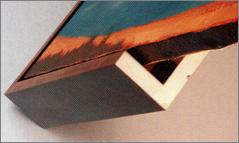 Photo 4
A stretched canvas is traditionally less than ⅛" to the frame face. With only ⅛" float space.
An uneven pour may be far closer to the frame face at some spots than others. Photo 5 shows the wax closer at the corners than the center. The float depth and float space may also be selected as an accent to help direct the viewers eye into the art. If the art is heavily textured and embedded perhaps a gold or silver accent frame face will help tie into the medium, while a wider float space may surround the art with an accented field of black—like a mat (photo 6).
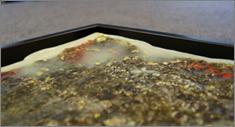 Photo 5
This uneven pour is far closer to the frame face at the corners and lower in the center.
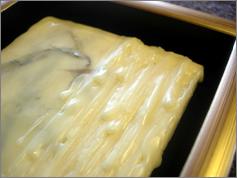 Photo 6
This small 4x4" textural panel is set a full ½" back from the frame face. The black lining seems to mat the art, while the gold face accents the color of the medium.
Design Proportions
Watch the proportions and comparison of the face width to the float space. If the face of the profile is ¼", the float space should be slightly less than or greater than ¼". Deckle drip art frequently has uneven edges with a float space of 1/16" at some points and nearly ¼" at others. A simple black narrow float often works well and helps keep a variation in the space making the art more interesting. A clean square edge cradle may be fairly evenly spaced with a ¼" face and 3/16" float space because of the crisper contrasts.
Always work with your framer to find the color, depth and space proportions that best enhance and protect your encaustic masterpiece.
END
Copyright © 2010 Chris A Paschke
For more articles on mounting basics look under the mounting section in Articles by Subject.
There is a special section in the library for all past IEA Framing Matters articles from Wax-On!
Additional information on all types of mounting is found in:
The Mounting and Laminating Handbook, Second Edition, 2002,
The Mounting And Laminating Handbook, Third Edition, 2008 and
Creative Mounting, Wrapping, And Laminating, 2000 will teach you everything you need to know about getting the most from your dry mount equipment and materials as an innovative frame designer.
All books are available from Designs Ink Publishing through this website.
Chris A Paschke, CPF GCF
Designs Ink
Designs Ink Publishing
785 Tucker Road, Suite G-183
Tehachapi, CA 93561
P 661-821-2188
chris@designsinkart.com