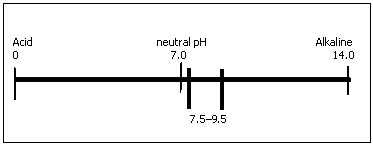
 Diagram 1
I just returned from a fabulous weekend at the IEA Retreat and Conference 2009 held in Carmel Valley, CA…and a great time was had by all. I gave a presentation sink mounting your original art on thin panels and 8-ply rag which I will write about next month, but this month I need to chat about a few things I heard while at the retreat.
Common Definitions
There are a number of words that are commonly used today that are commonly used in the description of art materials and framing products…including adhesives, and I think it's time to review these. Acid free is a term based on the pH scale of zero to fourteen (diagram 1). Zero is acid and 14 is alkaline with 7.0 being halfway and considered neutral pH. It is frequently used to promote marketing and sales of everything from adhesives to paper goods. Adhesive and paper products between 7.0 to 9.5 pH are considered acid free as defined by International Standards document 18902:2007 Albums, Framing and Storage Materials. The closer your materials are to this pH range the better.
Diagram 1
Like acid free, archival has become another term that is frequently used in marketing to promote sales. Originally meant to refer to materials that preserve art forever…no such materials currently exist so none can be archival. Museums have archives that house important art and documents in storage rooms that are humidity and temperature controlled, free of pollutants and ozone deterioration. Calling any product archival infers it will remain constant for centuries.
Types of Adhesives
Synthetic adhesives are divided into two categories: thermoplastic and thermosetting. Thermoplastic adhesives may be resoftened any number of times by the reapplication of heat making them less suitable for bonding encaustic art. Polyvinyl acetate (PVA)—also known as white glue—is the most common of these. The additional of a catalyst makes thermosetting adhesives undergo irreversible chemical change when they harden. Once hard, they do not melt or resoften when heated and are considered insoluble in common solvents. Thermosetting adhesives include epoxies, polyesters, and urethanes which are not fine art friendly and should be avoided.
Adhesives are available as wet glues, sprays, pressure-sensitives, and heat activated used in dry mounting. There are permanent and removable adhesives. Permanent is thought by consumers to mean lasting forever, but it should never be confused with longevity. Spray adhesives frequently state they are permanent, and when properly applied they may indeed be so…at that moment. They are designed to have tear strength—meaning the layers will tear apart in an attempt to test their fusion once fully cured—but over time they too will lose that paper tear strength and peel apart. At the IEA Retreat I discussed this very concept with an artist who had bonded her unsaturated encaustic monoprint to a sheet of clear acrylic for wall display. This will fail over time, though it is impossible to determine how long that will be. Spray adhesive should never be used for bonding art to any backing for display.
Chemicals are added to tape adhesives to keep them sticky. Pressure-sensitive tapes will hold until they dry out over time and will eventually fail. Acid free tape means the plastic or paper carrier is neutral pH while the adhesive itself is stable and inert. Though this sounds great, there will always be adhesive that soaks into art paper or board when tape is used, and that makes it non-archival. Another issue with pressure-sensitive adhesive is the potential for oozing and creeping. The adhesive could soak through paper from the back and cause visual stains under the wax image, so use of p-s tapes—including Velcro—should be avoided.
Wax as an Adhesive
In our attempt to locate an adhesive best suited to our medium we seem to be overlooking what is hiding in plain sight. When paper has been saturated with wax the only adhesive that will hold to it is wax. In fact wax is considered one of the very best and most archival, museum favored, materials that may be used for bonding, and is the adhesive of choice in museums. It is stable and will not react with any other element in a framing package to illicit a new chemical reaction, and is reversible so it may be undone without the use of solvents. In fact wax is the only adhesive that will hold a wax saturated paper to a decorative backing, though there are limitations. Wax, as any adhesive, needs to soak into the substrate (backing) to allow to truly fuse the layers. If attempting to bond directly to a nonabsorbent surface such as acrylic there can be no saturation and a weak bond results.
Archival Encaustics
I was asked about painting natural wax onto naturally lignin based wood products vs. 100% cotton rag board and why it mattered when using wax. Our medium is such that working on wood is acceptable practice and therefore there is no archival reason to paint on rag. Like wood, 8-ply rag is smooth and absorbent, but it may also be easily resized or trimmed, is thin enough for sink mounting, may be glued to a platform for a float frame, and it starts off white. True it is acid neutral where wood is not, but other than that rag is not better…only different.
For additional information and details on these adhesives plus techniques and applications are covered in chapters 1 and 2 of my latest book The Mounting And Laminating Handbook, 3rd Edition.
So enough about adhesives for now. They may not be a sexy topic but they are a necessary evil when considering the mounting options for your saturated encaustic, monoprint, or mixed media on paper. Now that you are familiar with more of the terms and facts about adhesives I will begin to discuss alternative techniques for display. This is only the beginning.
END
Copyright © 2009 Chris A Paschke
For more articles on mounting basics look under the mounting section in Articles by Subject.
There is a special section in the library for all past IEA Framing Matters articles from Wax-On!
Additional information on all types of mounting is found in:
The Mounting and Laminating Handbook, Second Edition, 2002,
The Mounting And Laminating Handbook, Third Edition, 2008 and
Creative Mounting, Wrapping, And Laminating, 2000 will teach you everything you need to know about getting the most from your dry mount equipment and materials as an innovative frame designer.
All books are available from Designs Ink Publishing through this website.
Chris A Paschke, CPF GCF
Designs Ink
Designs Ink Publishing
785 Tucker Road, Suite G-183
Tehachapi, CA 93561
P 661-821-2188
chris@designsinkart.com