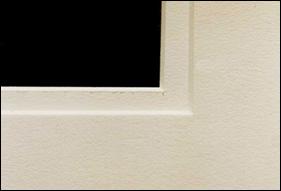
 Photo 1
Rough edges to any window mat bevel need to be lightly burnished for a polished finish.
Bone burnishers should be one of the most indispensible tools in framing, but is often overlooked in day-to-day use. So where is your bone anyway? You remember....the one you bought way back when you were told you needed one, then threw in a drawer waiting for when that time came. Or worse yet, you're one of the number of framers who consider themselves top notch designers yet haven't even invested in a bone at all. It's a small inexpensive addition that should be part of every framers basic tool kit—for two huge reasons: smoothing window mat edges (photo 1), and activating pressure-sensitive adhesives.
Photo 1
Rough edges to any window mat bevel need to be lightly burnished for a polished finish.
All forms of pressure-sensitive tapes, met embellishments, shipping tape and the like must all be burnished for proper activation. It is the P (pressure) in TTPM for pressure-sensitive adhesives. ATG tape is often used for holding mats together and applying dust covers to the back of a closed frame, but without burnishing or placing in a vacuum frame only about 25% of the activation occurs. To fully activate a P-S tape—such as decorative bevel wraps, butt joins (photo 2), or linen book hinging (photo 3) tapes must be aggressively rubbed to activate to roughly 80%. The final 20% occurs once fully cured.
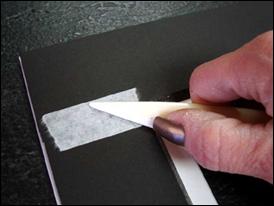 Photo 2
Tape should be applied and activated on all butt and bevel overlap joins.
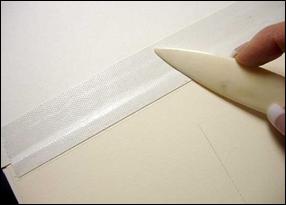 Photo 3
P-S linen tape makes a great book hinge, but it must be fully activated with a bone.
Types of Burnishers
Burnishers, also called bone folders, come in a variety of sizes, shapes (photo 4) and materials and are used extensively in the making and restoring hand sewn books and bookbinding. Burnishers are available as horn, stone, metal, wood, and synthetic but some can actually transfer a discoloration to mat board bevels. Bone is the best for framing by far. Some materials may also resist sliding along a toothed surface not allowing them to glide as smoothly as an aged or seasoned bone. Most alternative burnishers have actually been developed for other technical uses—vinyl transfer designs, gilding—and should only be used as a temporary substitute for bevel smoothing while you search for your neglected bone.
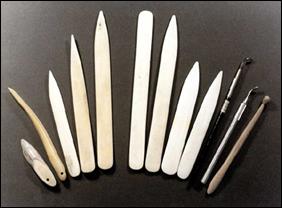 Photo 4
P-S linen tape makes a great book hinge, but it must be fully activated with a bone.
Seasoning A New Bone
A new burnisher should be seasoned with oil prior to use, much like you would a new gourmet sauté pan. Liberally apply a natural oil, such as vegetable oil, to all sides of the bone and rub off any access with a clean absorbent cotton rag. Let the new bone sit overnight to completely absorb the oil. Natural materials—not synthetic—will readily absorb the oil back into the dried bone. The original white color of the newly ground and polished bone will now appear more yellowed. The darkening of the bone is the direct result of oil absorption but will not leave the bone oily in any way. Part of the reason for seasoning is to help seal it from the dirt and oils found on human hands which can make dirty bones rather sticky. The benefits of a burnisher are the smooth gliding way they slip along the edge of cut paper or board. Older untreated bones will often take on the same yellowed or aged look of a freshly seasoned one. This comes from natural hand oils being transferred to the bone as it is used...along with dirt and other alien substances. This may make the bone sticky.
Lightly burnished mat edges may not be the solution to a hooked corner, but they most definitely should be the professional framers finishing touch. So if that bone you bought last year is buried in the back of a drawer somewhere, maybe it's time to dig it up and put it to some good use. After all, a bone in the hand is worth two in the drawer.
END
Copyright © 2011 Chris A Paschke
For more articles on mounting basics look under the mounting section in Articles by Subject.
Additional information on all types of mounting is found in:
The Mounting and Laminating Handbook, Second Edition, 2002,
The Mounting And Laminating Handbook, Third Edition, 2008 and
Creative Mounting, Wrapping, And Laminating, 2000 will teach you everything you need to know about getting the most from your dry mount equipment and materials as an innovative frame designer.
All books are available from Designs Ink Publishing through this website.
Chris A Paschke, CPF GCF
Designs Ink
Designs Ink Publishing
785 Tucker Road, Suite G-183
Tehachapi, CA 93561
P 661-821-2188
chris@designsinkart.com