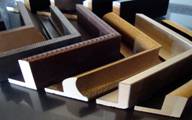
 Photo 1
Current L-Shape float profiles include straight, tall, curved, slant face, leafed, carved, wide and more.
Float frames are available in a number of styles and heights designed to accommodate a variety of canvas and hardboard cradle depths, and manufacturers are coming out with new styles and profile designs to meet our desires (photo 1). The L-shaped float frame profile allows for nearly any thickness of original encaustic to be fitted. Cradles and boxes are ready to install while hardboards my require a platform—or lifter—to raise the art closer to the top face of the frame. In upcoming articles I will cover float width and depth, but for now let's establish the same language for our future conversations.
Photo 1
Current L-Shape float profiles include straight, tall, curved, slant face, leafed, carved, wide and more.
For the sake of clarity in this series of articles, a standard float frame is an L-shape moulding (profile) that supports a stretched canvas or box from the back allowing for a variable space between the art and the side of the frame. The frame face is the visible top width of the frame. The float space is the gap between the frame and canvas, cradle, or art panel, not necessarily the support platform. The base is the back width of the frame that the art actually rests on (diagram). The long base profile is the most convenient since it is a simple screw mount into the wood.
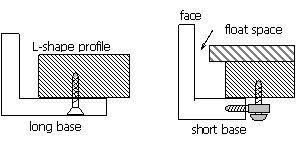
Photo 2 shows a ¼" platform lifter that has been screwed to the frame from the back. A completed panel of nearly any thickness (⅛" hardboard, ¼" birch or 8-ply rag) may easily be glued to the platform for display. At any time this wood platform may be replaced with a new platform simply by unscrewing it from the back and screwing in an unused one allowing for the frame to be reused for same size art. This type of installation will work for any L-shape frame profile (photo 3).
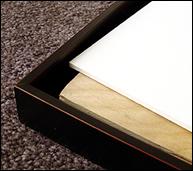 Photo 2
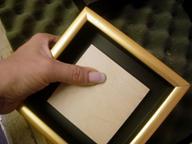 Photo 3
A float frame is the perfect choice when wax has been dripped over the edges—creating a deckled appearance—because the wax is delicate and may be easily broken during transport and display (photo 4).
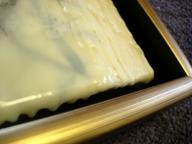 Photo 4
Surrounding the panel with a frame protects it from damage, and by recessing the art behind the level of the float face the front is also protected if ever laid face down. Since some artists prefer the cleaner look of a scrapped edge, allowing for the depth of the wax to become more visible, and a float frame works in this case too.
Float Frame Definitions
Float Frame — An L-shaped or stair stepped frame that does not cover the top edges of the art.
Float Mount — A thin art panel glued to a smaller platform, which is screwed to the frame.
Float Space — The gap between the frame and art panel.
Frame Face — The top edge of the frame.
Frame Base — The back width of the frame that the panel sits on.
Lifter — Also referred to as a platform, acts as a spacer raising the art closer to the face.
Platform — The removable ½" or ¾" plywood support that lifts a floated art panel from the back of the frame.
Selecting the right frame to best protect your encaustic painting is the main reason to consider a frame at all. Next month I'll explain more about frames well suited to our medium.
END
Copyright © 2011 Chris A Paschke
For more articles on mounting basics look under the mounting section in Articles by Subject.
Additional information on all types of mounting is found in:
The Mounting and Laminating Handbook, Second Edition, 2002,
The Mounting And Laminating Handbook, Third Edition, 2008 and
Creative Mounting, Wrapping, And Laminating, 2000 will teach you everything you need to know about getting the most from your dry mount equipment and materials as an innovative frame designer.
All books are available from Designs Ink Publishing through this website.
Chris A Paschke, CPF GCF
Designs Ink
Designs Ink Publishing
785 Tucker Road, Suite G-183
Tehachapi, CA 93561
P 661-821-2188
chris@designsinkart.com