Paschke Online
Designs Ink Publishing Article Archive and Reference Library
Articles by Chris A. Paschke, CPF GCF
"The Essence of Design: Rhythm"
April 2001
I heard a home interiors store radio ad the other day whose promo stated "select one of our tile designs for your new interior so that any other artwork in the room will never be noticed." As an artist and framer that comment really raised the hair on the back of my neck. We have been taught for decades to meld the framing with the artwork so they work together to best enhance the art, while the art always remained the focal point.
I sincerely hope that in the world of interior designs and architecture the same holds true. Why else would we quiz a customer as to the style and colors of a given room prior to framing their art? I realize this ad was attempting to promote the store's fantastic tile selection, but any room should all work together, harmonize, feel unified, yes, while each item within the room maintains the right to its own attention. Rhythm is the subject of this month's design column and it is one design factor that strongly integrates and helps pull all others together.
Elements and Factors
The elements of line, color, texture, shape, intensity, and space are all the ingredients or building blocks with which the artist or designer works. The factors of rhythm, emphasis, balance, and proportion are the mortar that hold them together or the directions for assembling them into an aesthetic and successful design. Together the elements and factors form the principles of design, and when working together successfully they will create unity.
Though rhythm falls into the category of factors, it sometimes fits better into the elements category. It is easily identifiable, countable and may or may not be actively utilized as a visual tool in a framing design.
By Definition
Rhythm, repetition, and dominance act as transitional agents for creating order out of forces which are otherwise in opposition. In the case of framing these could be mats and mouldings, the portions of the framing not necessarily considered by the artist or collector. They could also be the rest of the furniture and wallpaper within a room where the art is to hang.
Rhythm is the underlying principle of the universe, like a heartbeat, breathing or the cycle of the days into seasons. It derives from a Greek term meaning "to flow" and defines as a continuance or flow which is accomplished by repetition or regulated visual units. It is the use of measured accents, patterns, colors, space etc. to create a whole. If portions of the whole are visually reproduced in a rhythmic manner the design will often appear together, well thought out, and unified. Reintroducing similar patterns within different areas of a frame creates a unified feeling through rhythm, called repetition.
If the repetition of colors, textures and shapes helps establish unity, then modifying or isolating those same elements might create more variety through contrast. The repetition of a ticking clock fades into the background, while a frequently heard radio ad can annoy and repel rather than attract. Thus rhythm can produce contrast, variety and/or unity.
Rhythm surrounds us in most everything we do, hear and see. There are three basic natural types of rhythm. Repetition is found in a heartbeat, alternation with the ebb and flow of the tides, and progression as the gentle growth of a tree trunk into branches.
Repetition
The metric, mathematical beat of repetition uses the same visual element a number of times within the same composition. It is a recurrence, measure (such as meter), tempo or beat exemplified by walking, dancing or hammering.
The most basic repetitive moulding design will show a very distinct metered carving, almost like the ticking of a clock (photo 1). Rhythm is also shown in this photo by the repetitive use of the same moulding pattern in weights, widths and colors as a progressive repetition between the outer moulding and inner fillet.
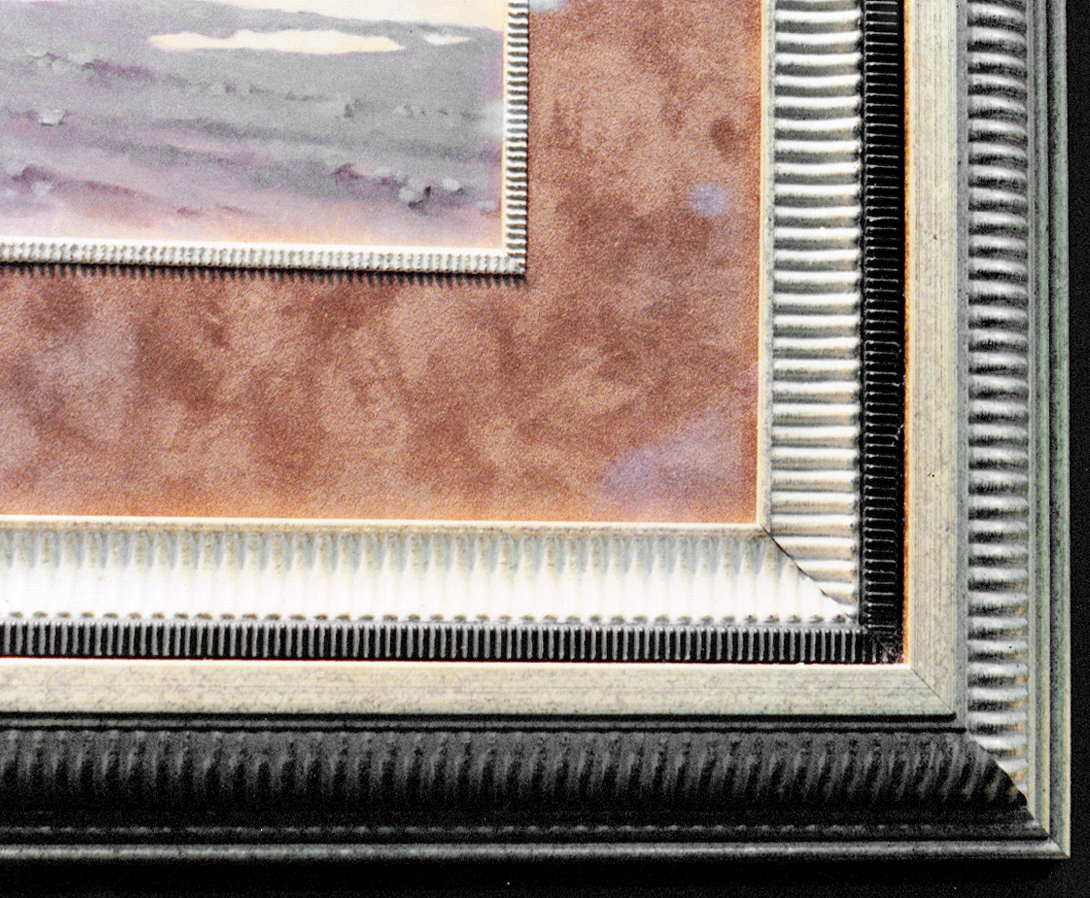 Photo 1
Metered repetition is illustrated in this moulding design of short lines perpendicular the length of the moulding. Rhythm is also shown by repeating the same moulding pattern in varying weights, widths and colors, known as progressive repetition. Frame courtesy of Victor Moulding Co.
Use of the same visual elements within the design of a particular moulding, establishes its motif. The motif is only one accent in an entire system of accents. A "beaded" fillet is an example of a familiar motif, for it establishes a very regulated visual beat. A small inner circular flower and leaf image may be repeated at spaced intervals along a matching moulding to establish a particular motif. Motifs are not one single part, they are always part of a larger whole.
Pattern uses line, shape, color, and texture to guide and direct underlying design structure. It establishes a harmonious relationship between individual parts which become similar or repetitive in character. Rhythm, repetition, alternation and progression all are systems in developing overall patterns. The moulding reflects the specific pattern established in the actually framed artwork, which leads the eye from one accent to another.
Repetition and rhythm are inseparable. Rhythm is the direct result of repetition, while repetition is a method used to emphasize visual units in a marked pattern. It is by far the easiest way to achieve flow and unity. By its very insistence, repetition demands visual attention through focal point emphasis, and no matter how briefly, allows the eye to pause or hesitate an a specific detail for further examination. Use of repetition does not always mean exact duplication, but rather a close similarity. Slight variations will add interest to a pattern which could quite easily become visually boring.
Alternation
The use of spatial repetition can create an alternating rhythm. It establishes a recognizable repetition but with a bit of a syncopated beat, in the case of framing design, one with a visual accent instead of beated similarity. If a flower design is repeated with no additional lines between it, it would be simple repetition, one in which the same image is duplicated over and over. The stylized flower in photo 2 repeats the same flower motif, but because of the parallel line dividers between the flowers it becomes an example of a slightly varied or alternating repetition.
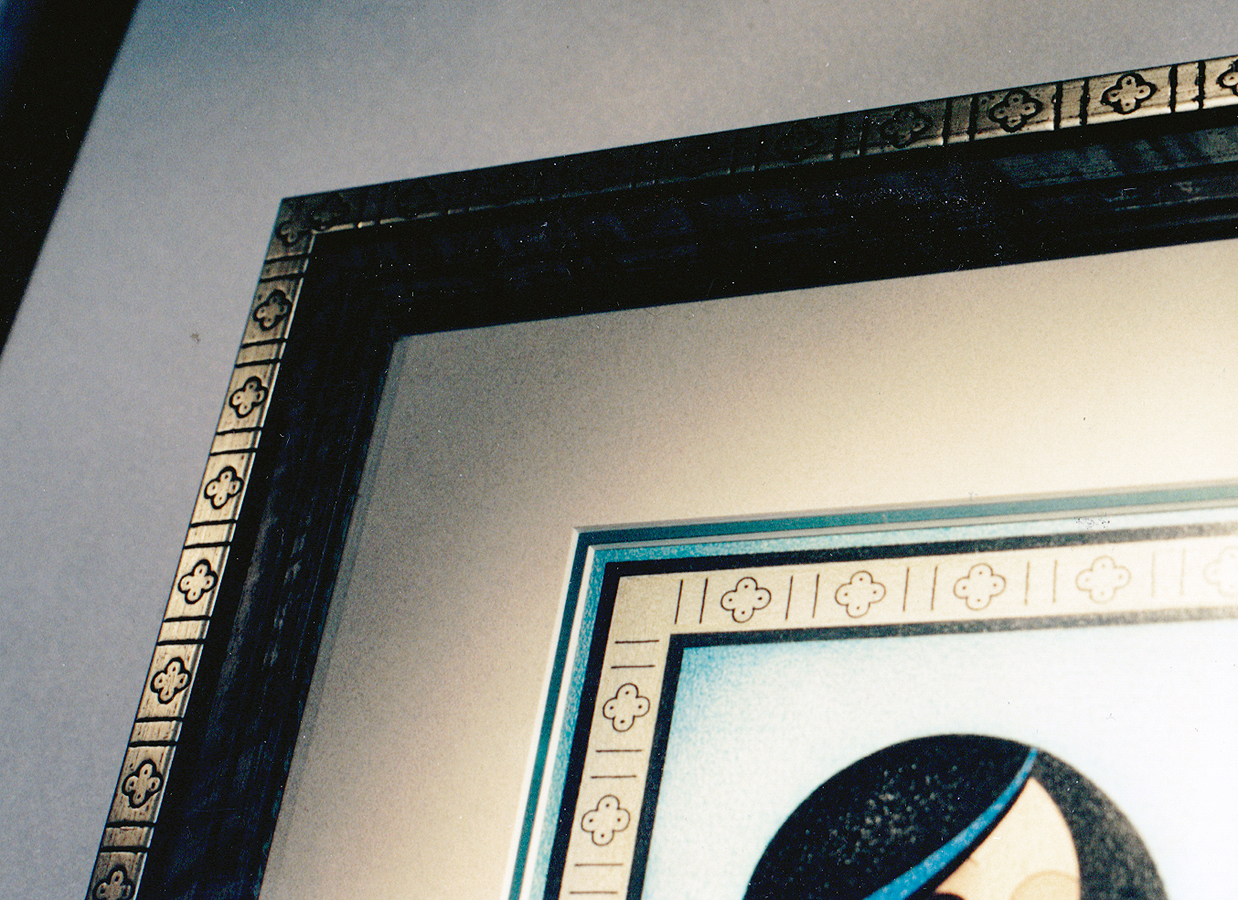 Photo 2
An example of alternating rhythm has been established between the flowers and the double line design between them.This creates greater visual interest through variation and contrast, while unity is achieved by the repetition of the same pattern in the art reflected in the moulding. Framing design courtesy of Arquati Moulding.
Progression
A sequential change during repetition as with the size variation of the tree trunk into the branches establishes progression of a rhythm. Sizes can grow, shapes can evolve from round to octagonal, colors can gradually fade from gray to green. These are all framing uses of a progressive repetition.
An excellent example of progressive repetition is seen in the award winning framing design by Ray Dwyer, CPF from West Wind Studio, Washington, CT (photo3). Line, color, space, and shape are supported by a good understanding of rhythm. The graduated circles visually draw the eye down into the smallest inner circle, the moon, within the print. The v-groove square surrounding the circles helps with the transition from inner round window to outer square frame.
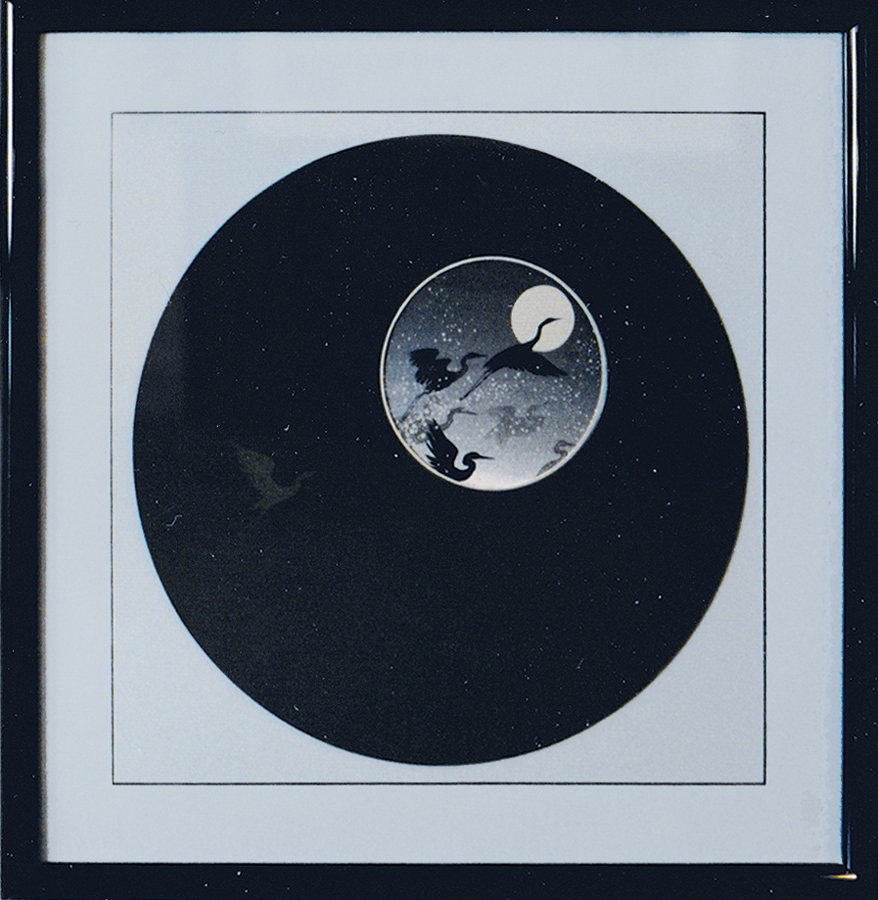 Photo 3
Rhythmic progression is seen here as the moon in the artwork is echoed by increasingly larger circles within the design.Although the v-grooved square creates contrast, as well as a transition from circle to square, it reflects the tension between the moon and mat and visual concentration remains on the image. Photo courtesy Ray Dwyer.
Dominance
Dynamic use of rhythm and repetition are frequently found in successful framing designs. Each portion of the design (frame, mats, colors...) must hold its proper portion of visual dominance, emphasis or attention. To get the viewers attention a featured portion needs to be in contrast with its surrounding area. This again will be examined more closely in Part Eleven: Emphasis.
The added diamond shaped pieces along the left side of the mat in photo 4 repeat the pattern from within the art image itself. They also integrate the colors and overlapping pattern of the Indian design. This example utilizes an attention getting contrast but does not overwhelm the rest of the design. Lack of rhythmic order or a weakness in establishing dominance can leave the viewer floundering for meaning or focus in a design.
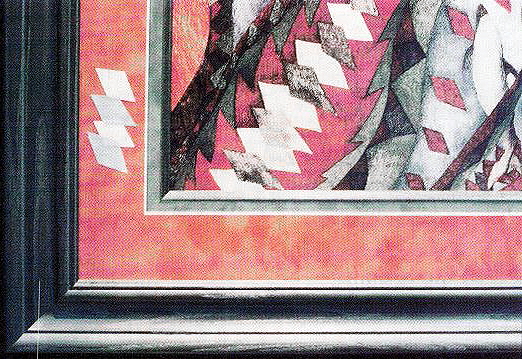 Photo 4
Line, color, texture, and intensity are illustrated here along with simple rhythm. The diamond shaped pieces along the left side of the mat repeat the pattern from within the art itself. They also integrate the colors and overlapping pattern of the Indian design.
Types of Rhythm
Too much repetition is also visually fatiguing and chaotic. Rhythm may be simple or complex in nature. Simple rhythm involves repeating only one measure within a frame. That does not mean it cannot remain a dominant visual element.Composite rhythm uses two or more recurring measures which exist simultaneously or a complex variation with a particular accent. This is the most common type of rhythm found in framing design.
Inlaid moulding emulates the patchwork concept behind the little heart print in photo 5, as a use of simple rhythm. Vinyl heat-set laminating films were used in a process known as 'contempo panel designing' to continue the patchwork pattern in the floor of the poster over onto the mat board in photo 6. Both of these examples use simple rhythm to repeat only one portion of a motif from within the artwork for continuity and emphasis. Both are strong design statements using repetition with a great deal of visual focus while only being an example of simple rhythm.
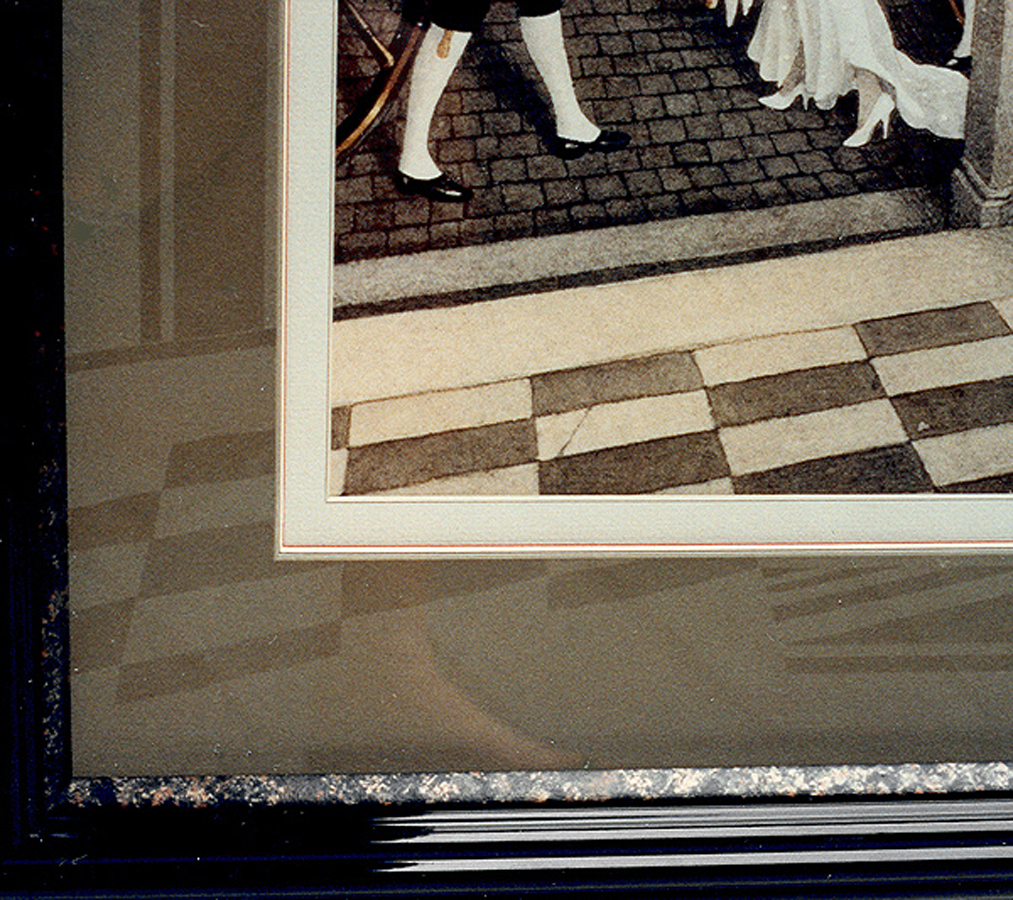 Photo 5
The patchwork pattern of heat-set laminating called contempo panel designing extends the checkerboard floor onto the mat illustrating yet another use of simple rhythm. Artwork detail courtesy of Hunt Corporation.
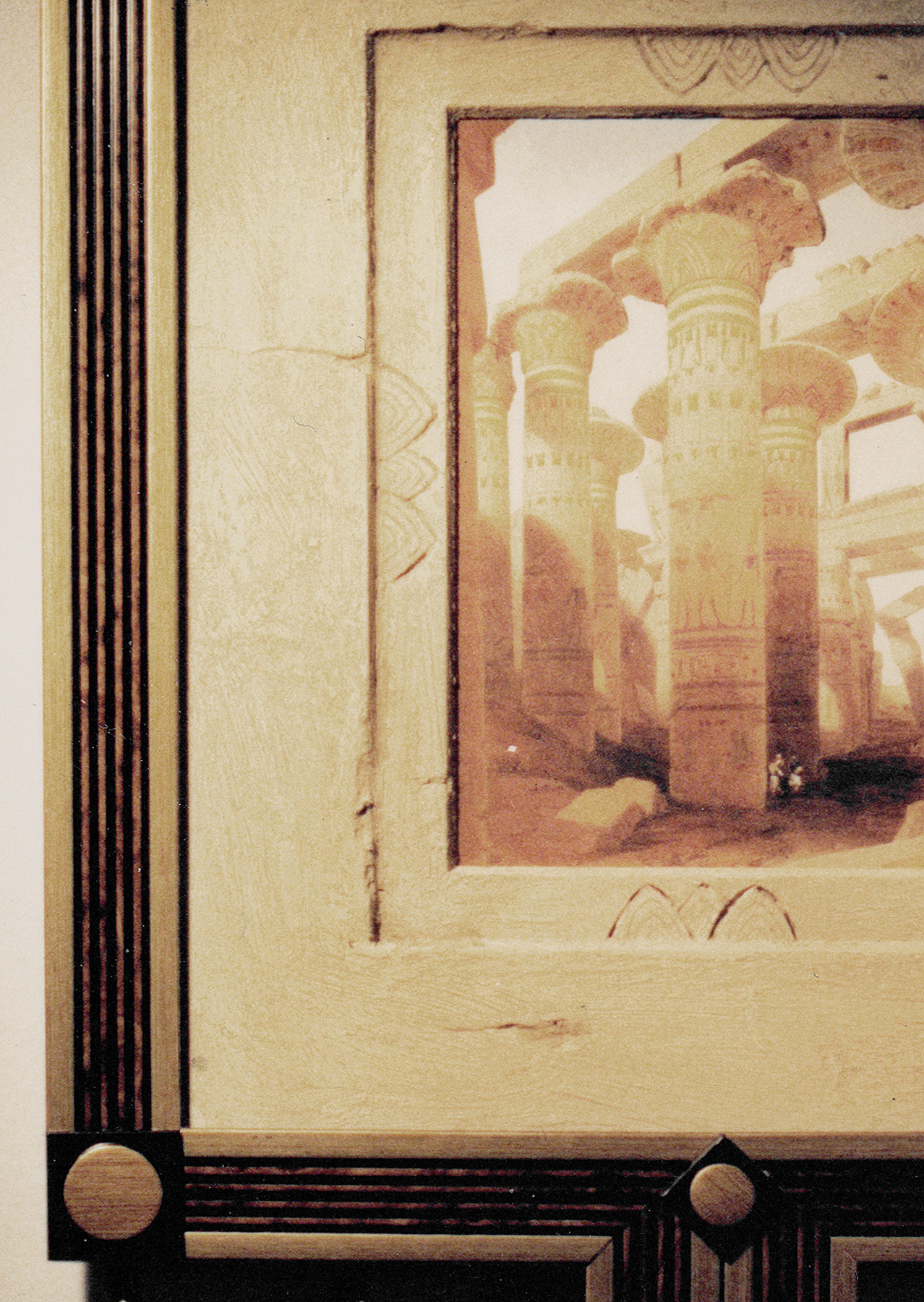 Photo 6
This is an excellent example of composite rhythm which replicates not only the motif but the colors, texture, and shapes from within the art onto the mat boards. Framed artwork courtesy of Arquati Moulding.
Composite rhythm is shown in the more complex imaging of the texture, color and arched motif of the columns replicated in the elaborately created mat work in photo 6. This design by Arquati Moulding successfully uses color, texture, intensity and rhythm in a dynamic presentation. It accomplishes a dominance of one basic visual idea, by creating a feeling of an overall harmonious relationship.
Rhythm is More Than Music
Within art, rhythm cannot be added to an artistic or visual composition, it must be implicit in the process of creation and in the experience of the artist during that process. In a sentence, it cannot be added after the fact...like a dab of blue paint. In framing, rhythm should become a principle that naturally finds its way into all successful designs. It aids in establishing balance, emphasis and the unity any design should be striving for.
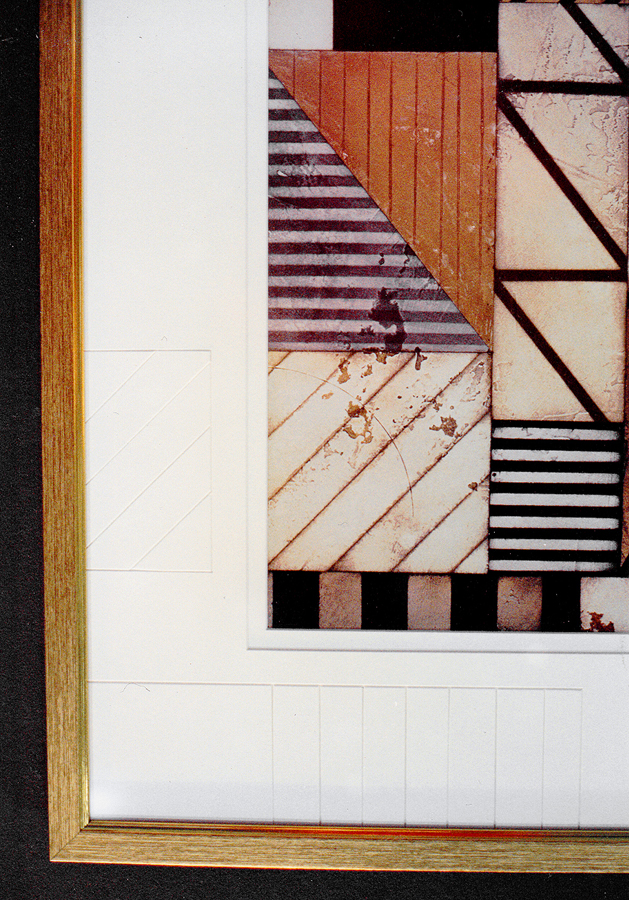 Photo 7
The top white mat board has been thinly v-grooved at the corners with diagonal, horizontal and vertical geometric patterns from within the contemporary abstract image. This was done in the attempt to replicate through simple rhythm the inner shapes in order to tie the outer frame to the inner artwork.
We have seen rhythm may be established as a rhythmical progression of movement and transition as in photo 3; or it can elaborately draw the eye into the image by composite rhythms, color, line and texture as in photo 7; or may be as simple as repeating shapes and patterns in different ways from within the art itself as in photos 5 and 7.
The elements of any design are the materials of the designer; the factors establish the methods by which these materials are set into motion or are used. Just as it is true that shape and space flow in and out of each other; that texture can be the result of highlights and shadows of line and color; all the principles should work together for a unified whole. If they are isolated then one may dominate the other and the design may be lost. Rhythm is the governing factor because of its connection to our heartbeats, breathing, the days, the seasons; the entire life force of our universe.
END
Copyright © 2001 Chris A Paschke
For more articles on mounting basics look under the mounting section in Articles by Subject.
Additional information on all types of mounting is found in:
The Mounting and Laminating Handbook, Second Edition, 2002,
The Mounting And Laminating Handbook, Third Edition, 2008 and
Creative Mounting, Wrapping, And Laminating, 2000 will teach you everything you need to know about getting the most from your dry mount equipment and materials as an innovative frame designer.
All books are available from Designs Ink Publishing through this website.
Chris A Paschke, CPF GCF
Designs Ink
Designs Ink Publishing
785 Tucker Road, Suite G-183
Tehachapi, CA 93561
P 661-821-2188
chris@designsinkart.com