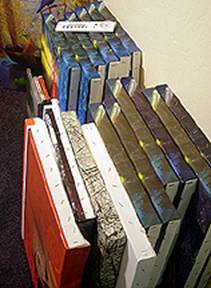
 Photo 1
In an effort to make the stretching and framing of digital canvases a little more predictable, I have begun a series of testing in an attempt to try to determine the causes and control of sagging of these stretched canvases. This article is an abridged version of the first part of a recent canvas test, with the full Phase One report currently available - along with spreadsheets of actual test results - on the PFM website.
Test Basics
The test has been on-going over the past year with Phase Two and Three on-going through the end of 2008 into 2009. Assorted cotton and poly blend canvases were printed on HP, Canon, and Epson wide format printers under manufacturer specs of 60°F-80°F at 40-60% relative humidity (RH) (photo 1). Phase One tested both gallery wrap (photo 2) and standard stretched (photo 3) digital canvases in an attempt to target the causes of sagging. Theories include: canvas weight; cotton vs. poly/cotton fabric content; swellable vs. porous receptor layer; dye vs. pigmented inks; and reactions to temperature and humidity.
Photo 1
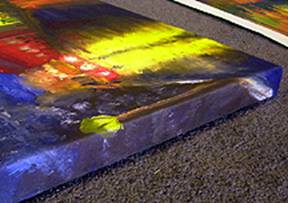 Photo 2
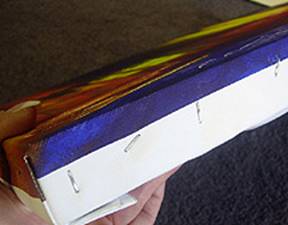 Photo 3
The two most common problems associated with digital canvases include sagging and cracking. There is a higher perceived value for images on canvas over the same image on fine art paper, and since canvases are traditionally stretched, most consumers prefer them framed that way. Test results showed that sagging occurred at various times, under various conditions and with various materials, often regardless of temperature or humidity; size of art; weight of canvas; or type receptor coating.
Ink Receptor Layers
Inkjet canvas must be coated with a treated surface layer allowing it to receive inks without bleeding. There are two basic receptor layers: swellable, designed for use with dye inks; and porous, designed for use with pigmented inks.
Swellable ink receptor layers — also called polymeric or nonporous coatings — are slow dry, moisture and humidity sensitive, relatively lightfast, and fairly resistant to gas fading pollutants. These produce inkjet images with a heat sensitivity that should be cold mounted.
Swellable layers are made of organic gelatin like polymers that surround and encapsulate the ink when it hits the canvas surface. The receptor layer then swells from the moisture in the ink from two to three times its original thickness as it absorbs (diagram 1). Once it has dried it returns to its original thickness while encapsulating the ink droplets. The swelled, puffed up coating is the reason it takes longer to dry once printed, and in turn is what makes them more lightfast than porous receptor layers. Swellable canvases for dye inks in the test were InteliCoat Torino 20G and Torino 21G.
Porous ink receptor layers — also called microporous and nanoporous— are fast drying and moisture resistant, but are considered more prone to gas fading pollutants and very susceptible to scratching and scuffing. Originally designed for use strictly with pigmented inks, these coatings adapt well to printing of both dye and pigment inks on canvases. These produce inkjet and wide format images that are totally heat tolerant. Because of the nature of the surface ink saturation, they are marketed as quick or instant dry, as the surface may be lightly touched without damage immediately after printing.
Porous layers consist of tiny particles glued together with air spaces between them that spread the ink out evenly penetrating through the top layer down to lower layers within the coating (diagram 2). When the ink dries, an embedded layer of colorant remains within the coating. Porous canvases used in the test included: InteliCoat Torino 20M, 21M, 17M, and Decor; Epson PremierArt WR; Fredrix Inkjet Canvas; Crane Museo Maestro Canvas-WR (water resistant); and HP Collector Satin Canvas, Collector Canvas, and Professional Canvas Matte.
Liquid Laminates, and Cracking
The application of a liquid laminate to a canvas surface increases water resistance; adds to the UV protection; and helps control cracking, splitting and flaking if receptor layers and inks. That said, it needs to be stressed that a framer should never consider applying any liquid laminate or spray to any digital image. Only the artist, photographer, or printer is allowed to apply a laminate.
Oil and acrylic paintings are originally painted onto a primed canvas that in most cases is already stretched. The original paint may crack with age with time and the canvases may indeed sag, but rarely overnight. Since digital canvases are stretched after printing, the cracked ink occurs immediately when it is bent or folded at the edges or corners allowing the dried ink and receptor layer to split revealing the uninked canvas below the surface. Liquid coatings may allow the inked surface greater flexibility during stretching that could prevent corner splitting or flaking at the staples.
Sagging
Sagging can be an issue at with any sized canvas, even small ones. I recently viewed a small 9"x12" nicely taut, newly stretched, inkjet canvas at a frame shop in South Dakota at 9am with a temperature of 80°F at 75%RH. That same afternoon it had relaxed to a very sloppy, saggy canvas with the temp at 100ºF and the same 75%RH. Phase One recorded positive results of tight to taut canvases at both 70%RH and 10%RH, but not all canvases. It appears humidity does play a part, but it is temperature fluctuation, humidity, canvas quality, and the other materials used that all determine if a canvas will sag.
Liquid laminates do not appear to have much effect on the issue of sagging. The most consistent canvases seemed to be the ones with a matte finish (photo 4), and were not marketed as water resistant. HP Professional Canvas Matte scored the best across the board, as a poly blend, mid-weight canvas with porous layer designed for pigmented ink (photo 5). Plus all canvases faired well between 50-70°F at 30-50%RH. So low, cool temperatures at lower to mid humidity combinations are best.
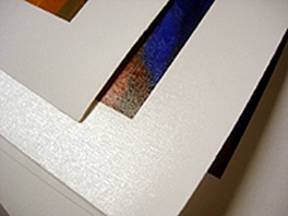 Photo 4
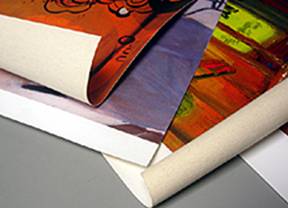 Photo 5
Conclusions
Since a framer is ill-advised to apply any liquid laminate to a digital, they are not included in this test. Oversized canvases are also not included, but as reported even a small 10x10" will sag under the right conditions. So far test results continue to be all over the chart. It does not appear to be the thread, weight, coating, or ink type that determines sagging. It does appear that high temperature, high humidity locations such as Hawaii, Illinois, Texas may need to consider alternative mounting methods for digital canvases. HP recommends misting the back of their canvas after stretching, but with an aqueous ink that might be risky.
In a beautiful 65°F, 50%RH temperature controlled gallery inside a 10-story building in Las Vegas last January there were numerous oversized canvases that looked fabulous. But there were also quite a few 6'x10' canvases that were so sloppy they waved as you walked by. As I studied the saggy canvases the sales person came by and asked if I liked the art and if I had any questions. I asked about the loose canvases and was told their framer didn't know how to properly stretch a giclée so they had to let him go. Poor framer, not even his fault.
There are no easy answers. In order to feel secure with the extended-term display choices for digital canvas, a new tolerance and acceptance of stretching and/or mounting options may need to be embraced by framers and galleries as well. Education is the key.
END
Copyright © 2008 Chris A Paschke
For more articles on mounting basics look under the mounting section in Articles by Subject.
Additional information on all types of mounting is found in:
The Mounting and Laminating Handbook, Second Edition, 2002,
The Mounting And Laminating Handbook, Third Edition, 2008 and
Creative Mounting, Wrapping, And Laminating, 2000 will teach you everything you need to know about getting the most from your dry mount equipment and materials as an innovative frame designer.
All books are available from Designs Ink Publishing through this website.
Chris A Paschke, CPF GCF
Designs Ink
Designs Ink Publishing
785 Tucker Road, Suite G-183
Tehachapi, CA 93561
P 661-821-2188
chris@designsinkart.com