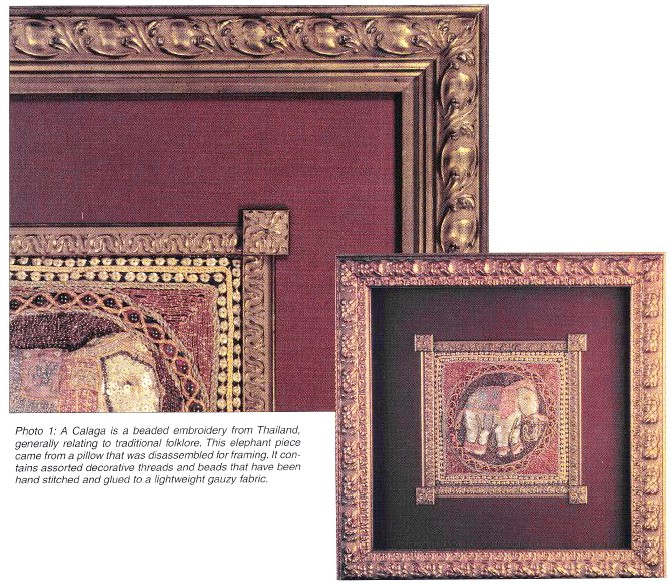
All portions of the design package (mats, mouldings, even glazing) incorporate elements and factors of basic design. Fundamentals are always present during the creation of mouldings whether from scratch or when modifying an existing moulding by altering it's color or texture. So creative moulding design could either be within the pattern of the moulding itself or the chopping and assembly of the frame.
A multiple sided frame design would be creative simply by altering the given fundamental rectangular shape of the frame. Stacked mouldings utilize the element of intensity to develop a creative design using many mouldings to accommodate extra required depth. The showcased design this month features a creative moulding of multiple stacked Castillano shapes to develop a new profile.
Defining the Project
It is Greg Perkins' CPF, Lawrenceville, Georgia, who offers our designed project for analysis, utilizing stacked Larson-Juhl mouldings to develop the required inner depth required to comfortably present the "Calaga" from his private collection (photo 1). A Calaga is a beaded embroidery from Thailand, using images and patterns generally relating to traditional Folklore. This particular elephant piece is the front section of a pillow that was disassembled for framing. It contains assorted decorative threads and glass beads that have been hand stitched and glued to a gauzy lightweight fabric.
Creating a Solution
The objectives of the project design were to carry the opulence and sparkle of the Calaga into the frame design without drawing attention away from the art itself. The frame was meant to feel as an intricate part of the beaded art as possible rather than appear as just an afterthought.
Mouldings and mat colors were chosen to blend with the warm colors of the beaded work while not competing with the central elephant figure. Crescent #7564 Maroon Linen perfectly matches the threads and glass pieces in the Calaga, plus it's texture closely emulates the base pillow fabric of the embroidery. Gold mouldings and fillets were selected specifically to set the framing apart from the dominantly silver elephant, while playing off it's accents of gold.
Analyzing Materials and Limitations
It was decided to frame the image tightly placing the inner fillet snugly against the outermost ring of beads to both support the lightweight backing fabric and to help draw focus into the central beaded artwork. The gold inner fillet was meant to draw the eye inward to the art from the ornate outer frame.
Extra depth was required to accommodate the 1" thickness of the embroidery, by either a spacer or traditionally constructed shadow box. Rather than a typical matboard spacer or commercially produced plastic spacers, a wide Larson-Juhl Castillano fillet #159WG was turned on side to continue both the design pattern and color of the outer frame moulding and inner accent fillet.
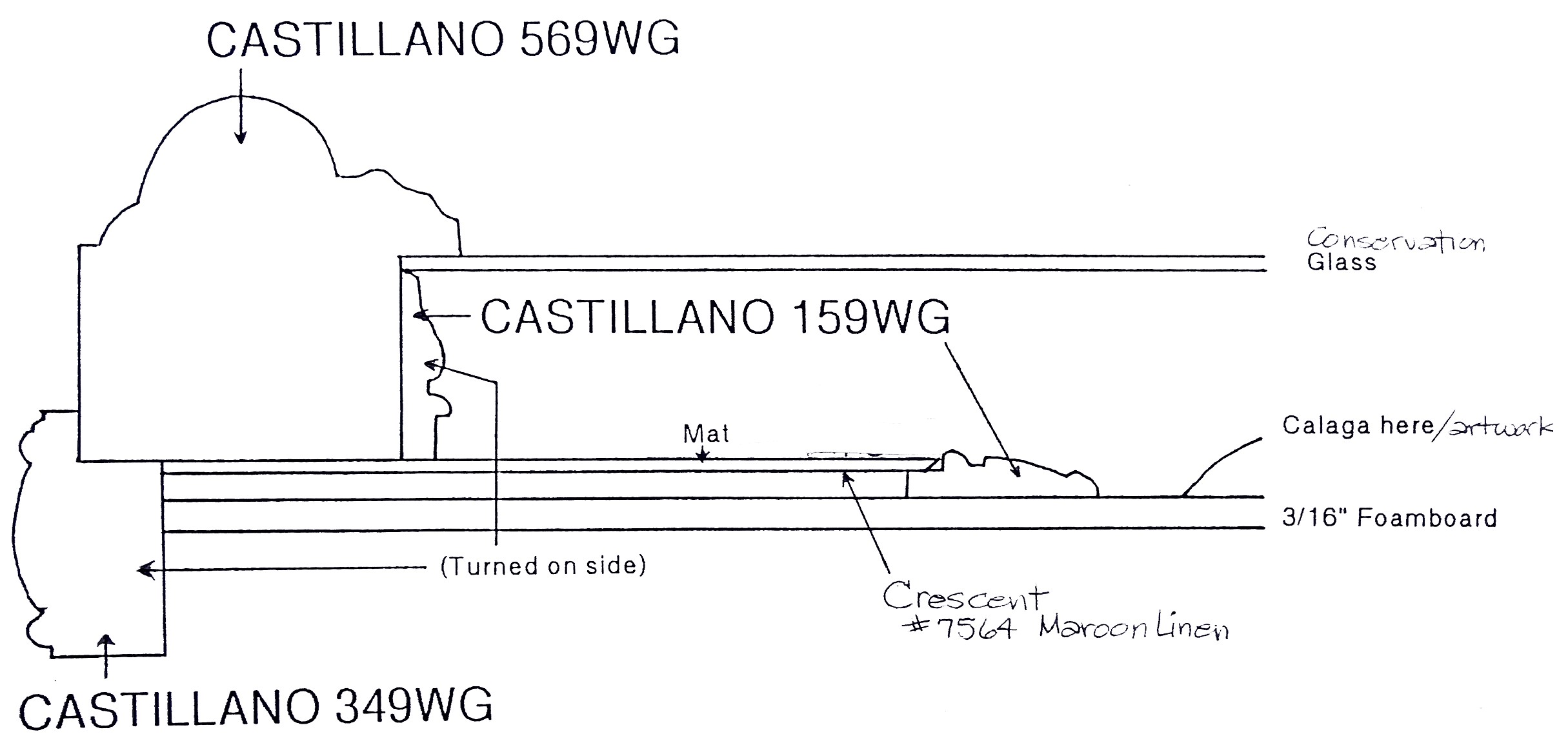 Diagram 1
Stacked mouldings were turned on their side to create the depth required to accommodate the 1" thick Calaga embroidery.
The outer frame is Castillano #569WG which has a warm gold color and decorative carved pattern that reflects the beading. Additional depth was then also required to extend the outer rabbet depth to allow for the inner turned fillet, so another Castillano #349WG was added to the outside. Frame dimensions were approximately 16"x 16", with 3-½" mat width and ¾" inner fillet.
Initial Overview (Who, What, When, Where, Why)
Focal point and visual control is easy to check. The Calaga was placed centered in a field of maroon linen creating a dominant central focus. The eye (who) dives right into the beaded elephant (what) rather than the outer beads, concentrating for awhile (when) on the detailing of the art, as it should. Then the focus spirals around it following the circular threads to the transitional square fillet where the eye is temporarily halted by the square decorative corners. The corners echo the overall square shape of the entire presentation, helping tie everything together.
Why all this occurs comfortably is attributed to a sound working understanding of design elements and factors and how to develop them into a unified presentation. The heavy outer gold stacked moulding could have easily overwhelmed a lesser or more simple inner piece of art.
Analyzing the Elements
The use of line makes somewhat of a statement because of the visually accented repetition of the liner, spacer, corner squares and frame. Since these same details fall into the discussion of shape they will be counted as use of shape rather than line...and never as both in this formula. Color will also not be counted here because only one color has been introduced in the mat backing. This singular color selection is a good choice since the art is bright and busy enough on its own.
There is a great deal of texture happening in the piece with metallic threads and glass beads directly contrasted by the linen fabric in the backing mat board. Texture is a given in the linen fabric mat (not the art) and although the Castillano is a heavily carved moulding, texture probably wouldn't be counted as an intense use of elements either.
Shape (1) will be the first counted element because the frame design is a square, altering it from traditional rectangular form. The repeated use of the square through frame, fillet and accent corner, as well as moulding patterns introduces a recognizable use of rhythm (4). This will be later discussed in the factors segment.
Highlights and shadows created by the additional depth of the shadow box develops an attractive use of intensity (2) in this project. The field of solid color enhances the art by attracting attention to it, and I feel the negative space (3) surrounding the elephant is a strongly used element.
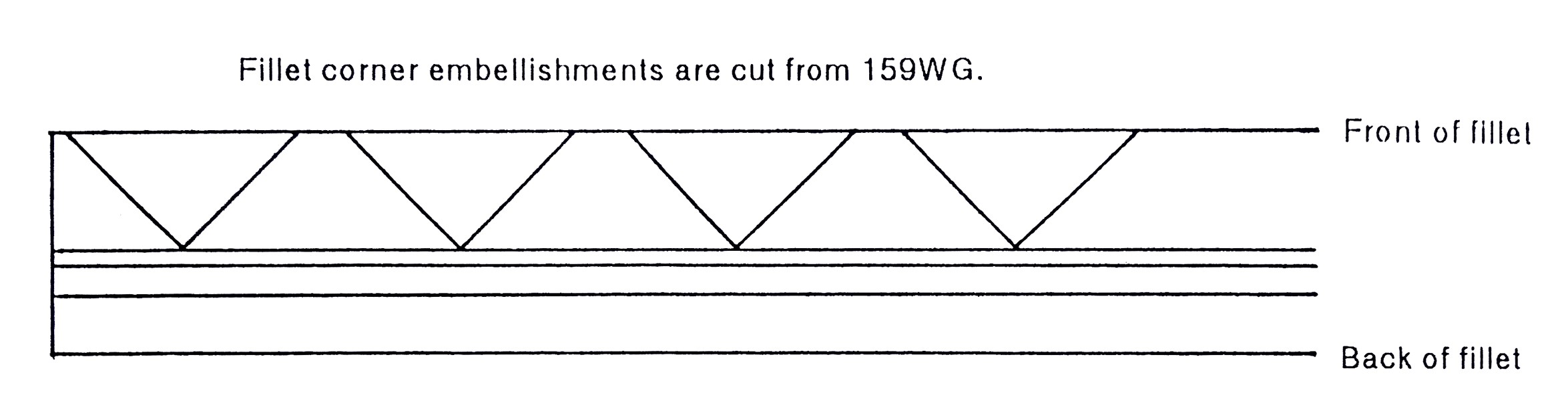 Diagram 2
Small square accent pieces were cut and mitered into decorative corners using Castillano fillet #159WG
Factoring it Together
The width of the surrounding maroon mat does not appear out of balance or proportion, while it is consciously noticeable. Proportions feel relatively appropriate for the dynamics and strength of the art with its glitter and beads. A less powerful piece would probably not have been able to tolerate the closely placed fillet without feeling crowded or overwhelmed.
Throughout the use of fundamentals, focal point remains on the elephant, but the decorative square corners do attract the viewer's eye. They not only reflect the rhythm of the repetitive pattern from frame to spacer to fillet but also reflect the small detail of the art that somewhat resembles the carved moulding. They were obviously used to echo the already ostentatious presentation and busy embroidery.
The eye has a tendency to flash from corner to inner artwork in an exited movement. Diagonal eye movements are both powerful and active, and traditionally make a strong positive emotional statement, so this piece feels very alive. Emphasis is skillfully used in this presentation, enhanced even more by the field of dark, plain maroon fabric in the surrounding mat. Again, this reinforces the elephant as the focal point.
This artwork (by being placed centered) is another good example of a symmetrically balanced presentation. True the Calaga itself is not a mirror image on both sides when divided down the center, but the framing places it centered and remains the same either side.
Rhythm (4) is wonderfully used in this piece, and most definitely countable. The embroidered multiple textures of threads and beads, highs and lows are all reflected in the selection of the Castillano moulding. Having repeated moulding rhythm as spacer, fillet and accent squares not only reflects the textural feel from the Calaga but also reintroduces the outer pattern inside the package drawing the eye inward.
Few Givens and Four Fundamentals
When counting the fundamentals in this project, notice there are a limited number of givens used to begin with. We accept the rectangular frame, base colored window mat having a texture and pattern all as givens. There is only one mat used appearing more as a field of fabric than a mat at all because of the tightly fitted fillet flush up against the Calaga with no exposed bevel. The format is square rather than rectangular and the overall design is simple dramatically accented by the stacked gold mouldings.
There is a fine line in this design between the almost cramped tightness of the inner fillet flush against the Calaga and the brilliant use of the same fillet to draw the eye into the concentrated central embroidery. Total number of counted fundamentals is 4.
Striving for a Unified End
Is this a well designed and unified project? Are the elements of line, shape, intensity and space used the best possible through proper proportion, balance, emphasis and rhythm? Does the piece feel too tightly held in too large a frame? There will probably be both opinions.
Sometimes a great design requires pushing the elements just to the edge, when is enough, enough? There is no definitive answer. The question becomes subjective and a matter of taste. That is why there are so many diversified variations during a framing competition of the same image. Though all fundamentals are generally identifiable, they may not all require center stage. Line may be identified as either a subtle ruling pen line or a ¾" wide Castillano fillet. Framing must enhance the art never overpower it.
I think this is a successful design, nicely showcasing a busy collage of handcrafted beads and bobbles. I love the side stacked solution to a need for deeper rabbet, a fitting presentation for a creative moulding theme this month. Well done and thank you Greg for this addition to
END
Copyright © 1997 Chris A Paschke
NOTE: A Calaga is a beaded embroidery from Thailand, generally relating to traditional Folklore. This elephant piece came from a pillow that was disassembled for framing. It contains assorted decorative threads and beads that have been hand stitched and glued to a lightweight gauzy fabric.
For more articles on mounting basics look under the mounting section in Articles by Subject.
Additional information on all types of mounting is found in:
The Mounting and Laminating Handbook, Second Edition, 2002,
The Mounting And Laminating Handbook, Third Edition, 2008 and
Creative Mounting, Wrapping, And Laminating, 2000 will teach you everything you need to know about getting the most from your dry mount equipment and materials as an innovative frame designer.
All books are available from Designs Ink Publishing through this website.
Chris A Paschke, CPF GCF
Designs Ink
Designs Ink Publishing
785 Tucker Road, Suite G-183
Tehachapi, CA 93561
P 661-821-2188
chris@designsinkart.com