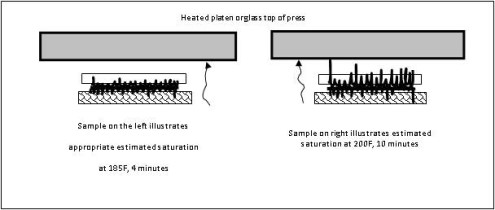
There appears to be a lack of understanding about bonding and saturation of adhesives. When lecturing and teaching about dry mount presses I always discuss time and temperature issues and how they impact adhesive saturation into any given project. But there still remains a confusion about what saturates, how much it saturates, how it can be removed (if it can), and whether it impacts the life of the image it mounted. All good questions and very valid. So let's go through them and try to clear up some of the confusion.
Which Adhesives Saturate
Porous defines as 'full of pores, permeable by air, water' and in this case adhesive. All adhesives saturate porous mountings. Even when using Japanese hinging techniques, cooked pastes will indeed saturate the upper ⅛" of the hinged artwork where the rice paper hinge is mounted. The difference between this type of mount and a full blown body mount, which the entire artwork flat mounted to a board, is the tiny area to which the hinge has been applied vs. submitting the whole image to saturation. In this case the adhesive is cooked starch, which is removable with water, hence the adhesive is reversible. True, there may still remain a small amount of adhesive in the art once removed but it is neutral, inert, and has only been applied to the top ⅛" in two small places.
Inert means it is stable and will not react with any other element to create a new chemical reaction. Most adhesives are inert. But that will still not make them conservation quality nor reversible, removable perhaps. Even dry mount tissues and films are inert. It is not the adhesive itself that makes a dry mounting technique nonreversible but rather the fact that adhesive residue will forever remain within the removed artwork from the mounting substrate.
When applying wet glues and spray adhesives controlling the amount of adhesive during application will heavily impact the saturation as well as the pressure or weight applied during drying. Though the same elements of time, temperature, pressure and moisture are applicable to all forms of mounting (even conservation) the degree and control of these is what makes the difference between a successful mounting and one that fails the test by bleeding through or lifting off.
If a wet glue is applied too thick and/or wet it could logically saturate a porous or very thin mounting. This is most often experienced when mounting thin rice papers or sheer fabrics, and dominantly very absorbent fabrics such as cottons, linens, or wools. Synthetic fabrics do not soak up moisture but rather will allow excess moisture or adhesive to seep between open weave fibers giving the appearance of saturation as with chiffon. Still undesirable.
Spray adhesives as with the above wet glues can soak through when overly applied. But in turn may not create the adequate bond when not cross sprayed during application, left for proper open time, or weighted as indicated by the manufacturer. In both cases excessive weight during bonding could also impact the saturation if liberally applied. Even pressure is required for good contact between project, adhesive, and substrate during drying and maximum bonding.
Mechanics of Heat Saturation
In a mounting press the heat source is in the top of the press, which is the platen or glass top. As the mounting package is heated to required bonding activation the adhesive is drawn toward that heat source up into a porous paper mounting. The longer a porous project remains in the press the more it will continue to saturating the paper. Additional time or higher temperatures will also impact the saturation of the paper.
Permanent dry mount adhesives bond within the press as they reach bonding temperature, while removable ones bond outside the press as they cool down under a weight. The hotter a vacuum or mechanical press is set in relation to the length of time the project is held within the press will impact the saturation level of the adhesive into a porous paper.
If the recommended temperature for a given adhesive is 185ºF and the average suggested press time is 4 minutes for a 3/16" foam substrate 24"x36" in size, the saturation of that adhesive will be just enough to adequately activate the adhesive for eventual bonding without overly saturating the paper (diagram 1).
If the project is left in he press too hot too long the additional saturation can dramatically effect the completed project, and be very well bonded. Too well in fact. When removable dry mount adhesives are overly saturated they may soak into the project paper being bonded so much the tissue-core becomes permanently fused between the substrate and paper poster rendering it a permanent part of the project and nonremovable.
Can Saturation be Removed
Once a project that has been dry mounted to the point of fusing to the poster or paper the only thing that might break the bond is a solvent, it is no longer considered removable. Wet glues may be water soluble, and sprays are often reactivated for removal by the application of heat. A hot hair dryer or shrink wrap gun might release that dry bond. When saturation has occurred the visual damage done to the project may never be removable.
When a solvent is used to remove a saturated adhesive it too will forever leave a residue in the paper or fabric. When resorting to a solvent to remove remaining adhesive the mounting should be checked to first verify it will not be damaged by the chemicals in the solvents. And though the bulk of the adhesive may be removed by a solvent, the difference in the saturated damaged area seen on the front of the project my maintain a certain translucency that the adhesive created. This may never go away. This is very evident in unmounted real vellum or parchment skins. The nature of them being dried skin soaks up the moisture in the adhesive and will hold on to it.
There is so much dry mount adhesive left remaining in the project once removed it will easily mount itself to a clean substrate with no additional adhesive required. One of the best ways to remove maximum adhesive from a removed project (without solvents) is by repeatedly remounting the project onto a clean scrap board using no new adhesive. There will be enough residue on the project to mount it two, three, maybe four more times by reheating a little hotter, a little longer, then reactivating for removal after cooling.
Does Saturation Impact the Mounted Image
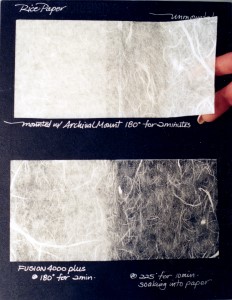 When a tissue or film adhesive has been removed from a piece of vellum there will remain a slight visual translucency. This is evidence of remaining adhesive that will never be fully removed, hence it is not reversible nor conservation. This adhesive is inert and will probably not damage, yellow, or age the vellum or paper in any additional way.
This translucency will easily occur when mounting any overly absorbent paper such as newsprint or mulberry rice paper. (photo 1) This sampler was mounted to illustrate both control of color tinting by selecting the correct clear adhesive and saturation principles. In this sample Seal Fusion 4000 rather than BufferMount tissue (formerly Seal ArchivalMount) was used. The white of a tissue adhesive negates the benefit of the colored (black) substrate the paper was mounted to. The upper right illustrates unmounted paper thickness and color. Lower left was in a press at 180ºF for 2 minutes while lower right was at 225ºF for 10 minutes, the results are obvious.
Nonporous Images and Saturation
Obviously if something is nonporous it cannot be penetrated by air, moisture, or saturated by adhesives. RC photographs, clay coated papers, and many synthetic fabrics are the most common of these. Unlike the glossy clay coated pages of the magazine you are reading, in which ghosting may occur as a result of the type on the verso side, saturation will not take place. Synthetics may appear to be saturated when they are actually it is only the melted adhesive that is glistening.
Saturation does not happen with RC photos either. This is why they are difficult to mount at times. Since there can be no locking of the layers together through adhesive saturation as in diagram 1 the bond is a surface connection only. These such items are only mounted as well as the bond has been created by using proper time and temperature ratios and adding correct pressure during bonding.
Saturation by Design
Saturation can also be something applicable to the basic design and be the desired look as when color tinting (photo 2). The certificate upper right is made of printer's vellum and is not real animal skin. It does not readily absorb adhesive due to its somewhat nonporous nature and will not saturate becoming even more translucent than it already is.
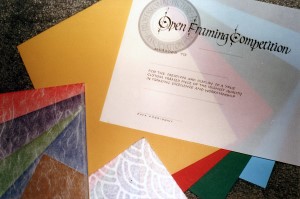
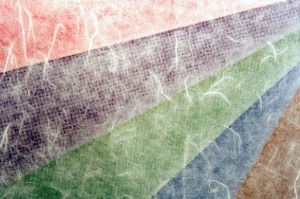
The lower two samplers of rice paper fully dry mounted over colored Canson papers illustrates different degrees of saturation. The far left has been layered with a sheer mulberry paper that has silk fibers throughout. It has been mounted at 200ºF for 10 minutes to allow more saturation and to let more of the paper color tint through to the front (detail close-up/photo 3). The lower right sample has a much heavier textured rice paper (about 3x thicker) layered over the same backing of colors, but at 200ºF for only 2 minutes. The shorter time held it to a good bond with limited saturation.
Soft absorbent rice papers will saturate entirely when deliberately left in a press to do so. If the sample in photo 3 was left in the press 200ºF for ½ hour or longer the mulberry tissue would disappear almost entirely and only the small squiggly silk fibers would be left visible. The surface of the board would have an almost waxy feeling though it is the melted adhesive that is being felt. If this is the desired look for a newly created mat surface, a spacer should be used between the mat and glazing so they do not stick together.
Controlling Saturation
In a recent project for Wild Apple Graphics I needed to make collaged layers of thin colored rice papers as backgrounds for Chinese characters. I wanted the deckled edges of the pulled rice papers to maintain their frayed edge appearance once mounted so the dry mount film I selected was trimmed smaller than the papers to be collaged. These were then mounted at 190ºF for 1 minute and cooled under a glass weight.
Once mounted the squares of adhesive under the rice papers had lightly saturated the papers to create the perfect bond, but the saturation showed through enough to disrupt the look. The papers were meant to be remain opaque but were rendered slightly translucent by the saturation, thus changing their color and allowing for the square of underlying adhesive to actually show through. I reselected a mounting technique and adhesive that would in no way saturate the thin rice papers of the collage. Perfect Mount Film was selected, a pressure-sensitive cold mounting adhesive to be used in conjunction with the cold vacuum frame. No saturation occurred, color ghosting from layers beneath were controlled, and the papers were left in their perfect natural color with four deckled sides.
There is always a solution to every situation. If saturation is a fear, concern or issue, then perhaps pressure-sensitive cold mounting may be the solution to controlling adhesive saturation, while heat dry mounting allows for color tinting. Conservation/preservation eliminates saturation altogether. Wet glue and spray adhesives are very controllable but there will be a degree of saturation when moisture and porosity are common denominators. Often all that is needed to understand is what the objective really is to find the correct solution.
END
Copyright © 1999 Chris A Paschke
For more articles on mounting basics look under the mounting section in Articles by Subject.
Additional information on all types of mounting is found in:
The Mounting and Laminating Handbook, Second Edition, 2002,
The Mounting And Laminating Handbook, Third Edition, 2008 and
Creative Mounting, Wrapping, And Laminating, 2000 will teach you everything you need to know about getting the most from your dry mount equipment and materials as an innovative frame designer.
All books are available from Designs Ink Publishing through this website.
Chris A Paschke, CPF GCF
Designs Ink
Designs Ink Publishing
785 Tucker Road, Suite G-183
Tehachapi, CA 93561
P 661-821-2188
chris@designsinkart.com